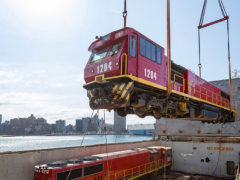
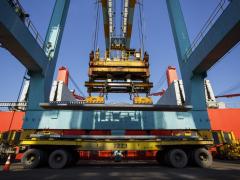
Ray Smuts speaks to financial journalist Stephen Mulholland for his take on the planned Coega port IN these days where accusations of racism and political correctness abound, prominent financial journalist Stephen Mulholland might be wondering - possibly tongue in cheek - whether branding the Coega development a "white elephant" catapults him into any one of those categories. That the oft-abrasive Mulholland, founder of Business Times, former editor of the Financial Mail and Business Day and one-time m.d. of South African Associated Newspapers, is an astute observer of the South African investment arena is beyond question. Even so, he does not pretend to be an all-round expert but like all scribes dedicated to their craft he"s an avid consumer of news in the making and his instinct tells him Coega is wrong. South Africa, he believes, has many more pressing needs; schools, hospitals, roads..... the list goes on. "I"m no expert but it seems to me Coega is politically motivated. It may or may not be coincidence that this region is an ANC stronghold desperately in need of economic stimulation. "I don"t see how Coega can work. It"s far from the major market and it appears that rail links would have to be subsidised." In a recent newspaper column Mulholland posed the question whether or not a deep-water harbour as envisaged for Coega was an employment generator. "Labour in the modern world is a commodity in massive oversupply as automation and computerisation make sweat and a strong back increasingly redundant in the workplace." Even though the Coega Development Corporation is now at pains to stress that an anchor tenant is not essential in order for the project to continue. Mulholland notes that mining giant Billiton withdrew as a would-be anchor tenant, followed by Ferrostaal. "The centrepiece of the proposed industrial zone at Coega, a stainless steel plant, will not work for the very simple reason that there is a vast oversupply of the stuff." Mulholland believes that South Africa"s money would be better spent on developing existing ports rather than Coega. "Most industry shipping leaders see no need for a new port, pointing out for example that Richards Bay is only 40% developed and more accessible to the industrial heartland. Our scarce resources can surely be put to better use." Turning to the arms procurement deal, Mulholland says Ferrostaal was supposed to have won a submarine contract worth R4,5 billion in exchange for its commitment to a R6 billion steel plant. He writes: "This is the wonderful world of arms trading in which, by some form of alchemy, a nation pisses away billions on sophisticated arms it will probably never use but receives in exchange more in jobs and investment than it spends." In conversation with this writer last week, Mulholland recalled an incident about two years ago when a former American diplomat-turned lobbyist for a well-known US helicopter manufacturer was assured of a contract by a senior government official provided a monthly payment of US$200 000 was made to a certain empowerment company. "The manufacturer responded that it does not do business like that," recollects Mulholland, noting that not a single American company benefited from the arms package. With hindsight, one wonders why? l The embattled Coega development project again bore the brunt of negative publicity recently when Polish construction company Navimor was reported to have quit South Africa in disgust, citing a lack of communication by the Coega Development Corporation. Navimor had been intent on building the deep sea port.
"Instinct tells me Coega is wrong"
Comments | 0
© Now Media. This content is protected by copyright and may not be adapted or republished. If you would like to discuss cooperation opportunities, please contact: editor@freightnews.co.za.