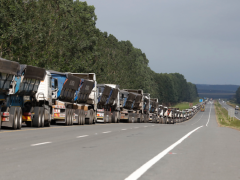
A miscommunication of information, in which Transnet Freight Rail (TFR) was wrongly accused, upset the entire business community at the southern end of Durban harbour alongside the container terminals last week. According to David Wilkinson, MD of Elcon Cranes, without notice to the business community, 70 concrete bollards were erected on a section of Bayhead Road, reducing this proudly just completed dual-carriageway to a one-lane, contra-flow road, while they laid a new rail siding. Witnessed by FTW, this led to a more than five-kilometre, three-lane jam up of trucks bound for the terminals, stretching all the way along Bayhead Road, and well into South Coast Road and across the new bridge leading over the railway to Sydney Road. There are an estimated 200 businesses on the waterside of the Bayhead Road, and all are completely dependent on it for delivery and collection access. This unpublicised TFR work, said Wilkinson, cost all of them – especially the three mobile crane hire companies, Elcon, Johnson Crane Hire and CTC Cranes – a lot of money, not to mention frustration. While Durban Harbour Carriers’ Association (DHCA) chairman, Kevin Martin, told FTW that the lack of notice from TFR was totally unprofessional, it turns out that it was not TFR that was laying the new rail siding. It was, in fact, according to TFR spokesman, Selby Dlamini, a Transnet National Ports Authority (TNPA) project. And, according to Neil Smith, TNPA maintenance manager for roads and tracks, they followed all the correct procedures. “We had to lay a new line,” he told FTW, “because the old one was in a dangerous state. Because it (Bayhead Road) is a public road, we have to ask the city for occupation three weeks in advance of doing the job. “They then advise the Chamber of Commerce, who, in turn advise all the members of the business community.” But somewhere in this communications loop a link has failed, because TNPA appropriately advised the Ethekwini municipality roads department, and received permission to “temporarily and partially close the road” and for “traffic to be diverted onto a contra-flow lane”. This, with the reference number 18/1/9, was forwarded to Smith by the deputy head of the roads system management – whose signature is indecipherable. But this advice went no further down the line, with everyone in the port area and in the communication loop unaware of the project until Bayhead Road was jammed up for kilometres. The FTW task now is to find out why the communication loop failed, and also why the TNPA did not advise the Durban Ports Committee and Transnet Port Terminals (TPT), its own main tenant of the Durban container terminal and Pier 1 terminal, as it is supposed to do when any port project work is due to be undertaken.
Information glitch jams up Bayhead Road
Comments | 0
© Now Media. This content is protected by copyright and may not be adapted or republished. If you would like to discuss cooperation opportunities, please contact: editor@freightnews.co.za.