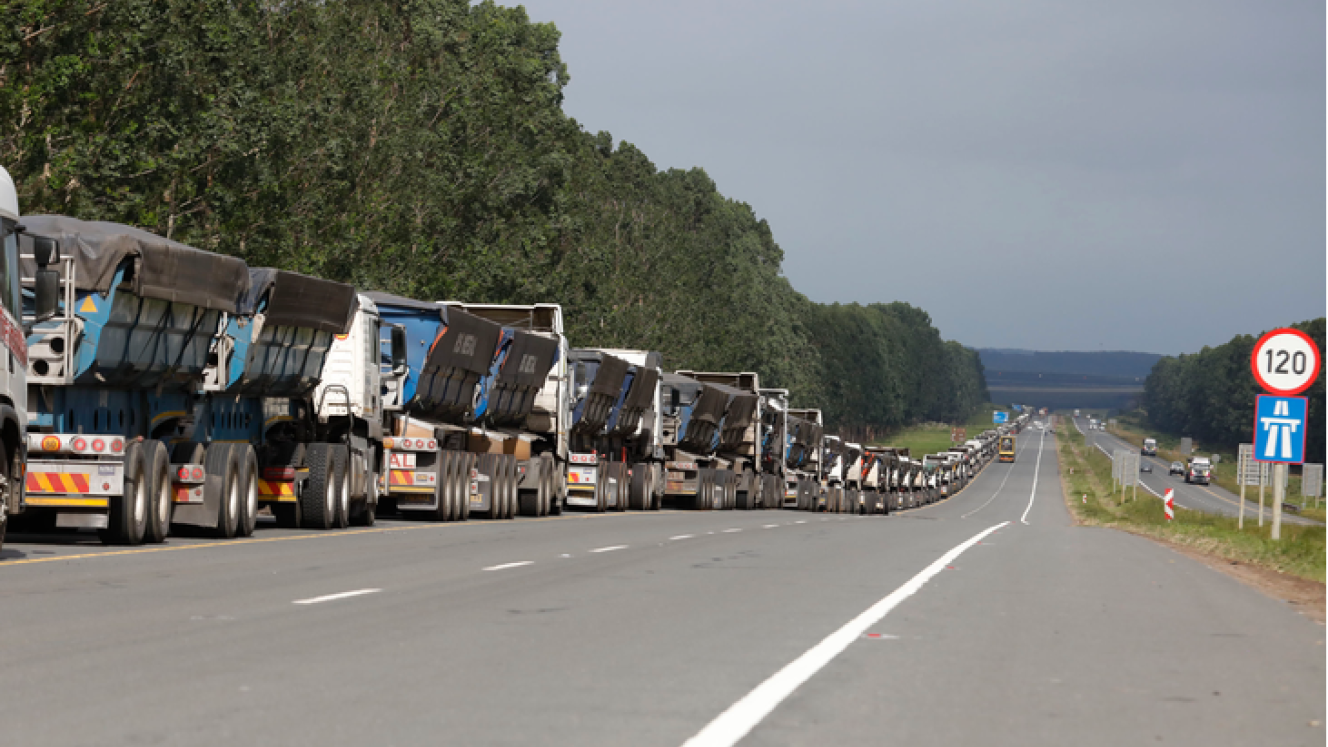
There is a growing feeling in the freight and transport industry that government’s proposed carbon tax will generate little benefit apart from a multi-billion boost to the government coffers. A major point that is being made is that the state hopes to gain R12-R17bn per year from the tax, but has refused to ring-fence this for purely emission reduction purposes. A basic protest is that there should not be more tax when there is already so much tax and red tape in the freight business. Also that costs like electricity and fuel will be significantly increased by such a tax. This will see companies’ budgets being stretched even further. And a KPMG study hinted that this might be the case. “If the carbon tax is used to increase the revenue collected by the state,” it said, “then the worries are well-founded.” The general proposal is that the national treasury should aim at having the carbon tax as revenue-neutral as possible. To achieve this, many countries have tended to offset the increase in carbon taxes with decreases in other taxes. And the reason for this is logical in the battle against emissions. It is a commitment to achieve the aims of the tax, which is emission reductions, rather than enabling a gain for public finances. But the SA government hasn’t taken this step, and the tax remains standalone. And the KPMG study showed just how much this could inflict on road transport companies. It took the hypothetical case of a trucking operation with 600 vehicles, each travelling 200 000 kilometres per annum, and travelling a total of 120 million kilometres per annum. Assuming the trucks carry 33 tonnes and return empty, then the emissions associated with the operation will be in the order of 18 500 tonnes of carbon dioxide per year. The first 60% of carbon tax is not taxable, so the truckers will pay R120 per tonne of carbon dioxide emissions on 40% of their direct emissions. So tax payable comes to R885 000 per year! Also a suggestion in the industry is that, as we compare to Australia in many ways, perhaps we should follow their move – drop carbon tax and put other measures in place to try to reduce emissions, including an emissions trading scheme. And the similarity between the two countries is strong. Australia also relies largely on coal-fired power and has a big mining sector. In 2010, Australia was the 16th biggest CO2 polluter in the world and SA 18th. If measured by absolute carbon dioxide emissions, SA produces emissions per capita in the region of 10 tonnes a year. Given this onerous situation, a number of people with whom FTW discussed the carbon tax, suggested that government’s intention to curb greenhouse gas emissions by 34% by 2020 and a further 42% by 2025 was rather a tough-to-achieve promise. Especially so as our main culprit for emissions is the Eskom generating sector. One estimate for this stated that electricity generation was responsible for an estimated 57.7% of SA’s greenhouse gas emissions in 2010. Synfuels production was responsible for 6.08% and road transport for 8.44%. And a further argument from the freight industry was that government was looking at ways of lightening the carbon tax burden on an already cashstrained Eskom, and possibly exempting it from some of the conditions for emission reduction. But the industry’s case was that coal-fired power stations were the most cost-efficient means of generating electricity in a coal rich country. And that talk of substituting nuclear power for coal-fired was purely a financial disaster – apart, said some cynics, from those who shared the backhanders which appear an inherent part of major deals like this in SA. Philip Lloyd of the Energy Institute at the Cape Peninsula University of Technology pointed out that nations that have tried to set up carbon limits were abandoning them when faced by reality. INSERT R885 000 The estimated annual tax payable by a 600-vehicle company travelling a total of 120m kms a year.
Industry spells out flaws in proposed carbon tax
Comments | 0
© Now Media. This content is protected by copyright and may not be adapted or republished. If you would like to discuss cooperation opportunities, please contact: editor@freightnews.co.za.