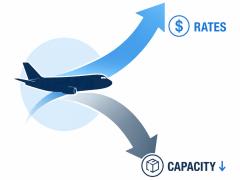
A transition from Just-in- Time (JIT) to Just-in- Case (JIC) inventory management is impacting global airfreight logistics. JIT minimises inventory by ordering goods only as needed, while JIC builds resilience by holding larger safety stocks. Disruptions such as extreme weather, Covid-19 shutdowns, geopolitical tensions and port congestion have encouraged many firms to adopt JIC practices. While this provides a buffer, airfreight is still needed to carry cargo when vessels, rail or road transport is disrupted long enough for inventories to run down. Airfreight also has a role to play where companies distribute inventory across multiple locations to reduce supply chain risk, particularly when emergency replenishment of regional distribution centres is needed. Industries such as electronics, pharmaceuticals and automotive manufacturing rely on airfreight to avoid production interruptions and maintain service levels. Including airfreight as a backup means of transportation strengthens supply chains. Cost is a deciding factor. The Council of Supply Chain Management Professionals’ 2026 State of Logistics Report found that the airfreight market was shifting toward value-dense cargo where speed and reliability outweigh freight cost. “The clearest and most consequential finding of this year’s report is that the disruptions reshaping logistics are no longer temporary, but structural – and geopolitics is the primary engine driving that shift. “Resilience is no longer an attribute that organisations aspire to, but the minimum viable condition for operating,” it states. Locally, the Department of Transport’s airfreight strategy for South Africa notes: “Growth in airfreight is unlikely to occur from capturing freight from other transport modes. “It would rather be stimulated by economic growth, in general, by increased production sophistication (less export as unprocessed bulk and more as value-added goods such as electronics) and by having a more outward-looking trade orientation (as promoted under the AfCFTA).” This view is supported by IATA’s latest industry statistics, which show a modest 0.7% growth in cargo between 2025 and 2026, generating $162 billion in revenue for airlines, which is well down on the $210bn Covid lockdown– induced peak in 2021. To make informed decisions, cargo owners and logistics services suppliers need to be plugged into global events and trends, according to the report. “The enterprises pulling ahead are those that have built the organisational and technological infrastructure to operate adaptively, which means sensing changes faster, making better decisions under uncertainty and reconfiguring resources more quickly than their competitors”. ER
Industry shifting to value-dense cargo
Comments | 0
© Now Media. This content is protected by copyright and may not be adapted or republished. If you would like to discuss cooperation opportunities, please contact: editor@freightnews.co.za.