While the African Continental Free Trade Area (AfCFTA) was signed amid much fanfare at the African Union Extraordinary Summit in Kigali, Rwanda last week, many in the freight industry are sceptical.
One FTW reader, describing the 40 years of negotiations around the AfCFTA as “a joke”, questioned whether the resolutions would ever reach “the man with the stamp in hand” at the border.
Gavin Kelly, technical and operations manager for the Road Freight Association (RFA), told FTW that if this meant lower transport costs and fewer delays, it would be a good move. “However, I don’t see countries letting go of duties (which is revenue generation for them) and there would be the smuggling aspect to deal with,” he said.
Kelly queried what this would mean in terms of South Africa being able to sell its products within Africa.
“Will there be no protection between states to ensure industries do not collapse? Think about the clothing, electronic goods and FMCG industries that were hit with cheap products from around the world.”
Michael Henning, sales manager at customs software solutions company Easyclear, agreed that it could make a difference in fast-tracking trade and trade facilitation, but highlighted his concerns around the controls that would be put in place to manage the process, “which in turn may produce red tape that will negatively impact the free trade agreement”.
A cross-border trader who preferred to remain anonymous pointed out that for the AfCFTA vision to become a reality, there would have to be stability, good governance and no corruption on the entire continent.
“Furthermore, regardless of the free trade area, each country would still maintain their current system to maintain control – and these are at the root of all delays.” He said that while it might be good for South Africa and Nigeria for increased exports, the same delays would be experienced in getting the product to market.
Yet another anonymous trader told FTW that the European Union was a good example of “what not to do”, pointing to the current Brexit negotiations as the United Kingdom works on extricating itself from the trade bloc.
He believes South Africa will have to follow the same route when they eventually figure out that financially it is draining their economy to the benefit of the poorer nations and they can no longer afford it.
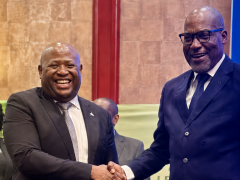
While the South African government welcomed the “historic moment”, president Cyril Ramaphosa indicated that he would not sign the AfCFTA until he had widely consulted cabinet, parliament and the National Economic Development and Labour Council (Nedlac).
“We are really going to clean up the process of ensuring everyone is on board,” he said, adding that South Africa wanted free trade in Africa. To date, a total of 44 countries have signed the AfCFTA while 27, including South Africa, have signed the protocol to the treaty establishing the African economic community which facilitates the free movement of citizens on the continent.
Moussa Faki Mahamat, chairperson of the African Union Commission, said he hoped all 55 countries would adopt and ratify the AfCFTA to ensure it entered into full force before the end of 2018.
Once ratified, the AfCFTA is expected to create a unified market of US$1.2 billion and a gross domestic product of US$25 trillion.
Ratings agency Moody’s – which gave South Africa another stay of execution over the weekend by retaining the current credit rating and changing the outlook to ‘stable’ – has said the AfCFTA could improve the continent’s overall credit profile.
Moody’s managing director for credit strategy, Collin Ellis, said in a recent report that countries with larger manufacturing bases and better infrastructure – such as South Africa and Kenya – were more likely to benefit from further integration.
INSERT AND CAPTION
I don’t see countries letting go of duties. – Gavin Kelly