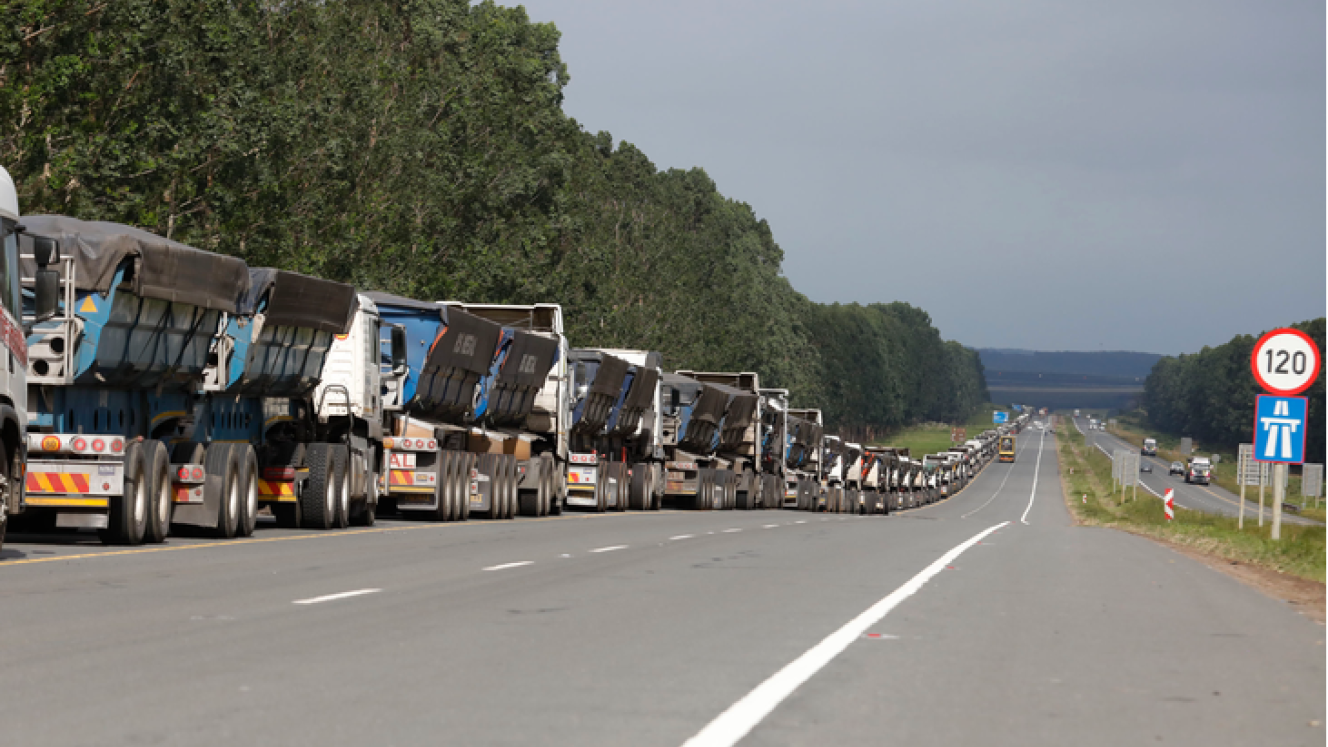
Moving minerals from road to rail has been slow going in South Africa. A variety of reasons are at the heart of this – ranging from uncompetitive pricing structures to the unreliability of delivery. Not to mention the lack of infrastructure. It is no secret that the state of a country’s transport infrastructure determines the performance and growth of its economy. In South Africa both road and rail infrastructure have been declining. Various experts – including Professor Jan Havenga of the Centre for Supply Chain Management at the University of Stellenbosch – have been arguing for more cargo to move to rail, calling for an intermodal system where both road and rail play a significant role. Yet the market share being grabbed by rail is low and many argue the successes being achieved are nothing more than the expected volume increase in the commodities being moved and have nothing to do with lower volumes on road. South Africa, however, does boast one significant rail success story. The Sishen-Saldanha railway line, also known as the country’s ore export line, has proved that rail can work successfully when all the stakeholders in the supply chain are committed to the same outcome. Every year some 58 million tons of iron ore and two million tons of manganese are moved from the mines in Sishen in the Northern Cape to the Port of Saldanha in the Western Cape – a distance of more than 800km. The single heavy-haul line, designed with crossing loops so that trains travelling in opposite directions can pass, sees the cargo moved daily in what can best be described as a smooth, well-oiled operation. Experts agree the success of this rail line, where the average length of a train is 342 wagons, is thanks to the buy-in of the entire supply chain. Robert van Rooyen, terminal manager for Transnet Port Terminals at the Port of Saldanha, says operations are geared towards receiving the ore trains. A rail offloading area where two tipplers are at work is situated at the entrance to the port. Two wagons are tipped simultaneously, dumping 200 tons of iron ore at a time. The trains are not decoupled and are shunted into the offloading area in the most efficient manner possible, moving as fast as possible. “The rate of offloading is around 8000 tons of ore per hour,” says Van Rooyen. “And every 90 seconds we tip 200 tons of iron ore in this fully automated system in order to turn wagons around as quickly as possible.” According to Kumba Iron Ore, one of the largest iron ore producers in Africa and the biggest user of the railway line, the success of the Sishen-Saldanha line is thanks to the ongoing integrated planning and cooperation between the public and private sectors in the country. Also, at the mines in the Northern Cape operations have been put in place to load wagons as quickly and as efficiently as possible. It only takes two hours to load a set of 114 wagons. “It really is about working together,” says Van Rooyen. “Everyone works towards the same goals. Our plans were to increase our capacity significantly but in conversation with our customers these plans have been downscaled. We will ultimately be able to handle 82 million tons at the port and along the railway line but our immediate aim is to move to 74 million tons per annum as that is all that is required.” It is part and parcel of the line’s success, says one commentator. “It is a completely collaborative approach and if we want to see more cargo moving to rail this is going to have to be replicated. It cannot just be the rail and port operators that come to the party but also the cargo owners all working together towards the same goal. Only then will we begin to really see cargo move onto rail.” This is reiterated by Havenga who says that in the South African environment it is crucial that real investments in port and rail networks are made but also “that we see far greater collaboration than ever before if we want to remain competitive in the global market”. Shifting bulk long haul freight to rail has to be a priority but this will only come about if the service on offer is reliable and efficient and there is collaboration along the supply chain. CAPTION Every year some 58 million tons of iron ore and two million tons of manganese are moved from Sishen to the Port of Saldanha. Photo: Mining Media Club South Africa
Industry buy-in makes Sishen a well-oiled operation
Comments | 0
© Now Media. This content is protected by copyright and may not be adapted or republished. If you would like to discuss cooperation opportunities, please contact: editor@freightnews.co.za.