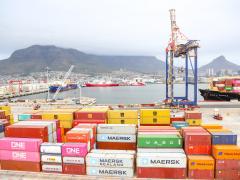
An idea proposed by the Brazilian and Indian industry associations at the tri-partite summit recently held in New Delhi, India, could have a critical effect on the port of Durban. At the India-Brazil-SA (Ibsa) summit, the two associations – disturbed at what they feel are poor transport connections between the three countries in the trade alliance – called for an SA port to be used as a transhipment point to reduce the cost and the time to ship goods between the member countries. And they named Durban as the main possibility. The Brazilian National Confederation of Industry (CNI) recommended to Ibsa delegates that each country designate at least one of its ports as a hub for trade among the three nations. The three countries should increase the efficiency of their port terminals “to reduce the time for loading and unloading of ships and, consequently, the total duration of trips”, their report said. It added: “The main intra- Ibsa cargo transhipment operations should be concentrated in an SA port. For this purpose, a cargo storage structure should be set up next to the port selected, to concentrate the cargo to be used by Brazilian and Indian companies.” It recommends Durban for this purpose because the port already handles 60% of the country’s containerised cargo movements. CNI's Indian counterpart, the Confederation of Indian Industry (CII), made a similar proposal. But members of the Durban seafreight industry are not too happy at the idea of increasing the transhipment boxes at the port by a significant amount. First of all because it might suit the lines, and earn Transnet Port Terminals (TPT) a small sum (full handling charges, but cut-price storage fees) – but it earns the private sector landside operators nothing, and puts only a little into the national economy. But secondly, and most importantly, the Ibsa transhipment plan could throw a spanner in the works of the port’s container terminals. “It would certainly be of concern if it means that the number of transhipments increases dramatically,” said Paul Rayner, MD of container transporters, DTB Cartage. The industry is already expressing complaints to the port management about the current excess of transhipments. According to information fed to FTW by another source, the ideal balance of import, export and transhipment boxes at normal times is 33.3%/33.3%/33.3%. In quiet times, the ratio of transhipments can go up to 35%-38%, he told us. But, on October 22, for example, the ratio of transhipments in the 14 644 boxes at the Durban container terminal was 6 197 – 42.3%. It all depends on what the extra transhipments do to the level of stack occupancy, according to Rayner. “The higher that is, the slower the terminal goes,” he said – pointing out the logic that more boxes means more machine moves to get to the required boxes, means more time. “At about 70%-75% occupancy you start to have problems.” Another executive in the freight industry told FTW that there was only one answer to the problem. For Durban to take the Ibsa transhipments – but, if that threatens congestion, to divert other transhipments elsewhere. “I can’t see Transnet taking on too much,” he said, “because, if they do, it would jam up the port. “The excess could be hubbed through another port along the coast, such as Ngqura.” That, he added, would also satisfy the government’s desire to have the new deep water port – as a main southern hemisphere container hub. And it is believed that has already been in Transnet management’s mind – with Durban, Richards Bay and Ngqura all being looked at as future hub ports. However, this diversion idea also met with screams from at least one shipping line executive, who told FTW that it would probably mean the lines having to make an extra port call in SA – because Durban is distinctly the preferred port for the huge volumes of traffic coming from and going to the SA industrial heartland of Gauteng. This adds a huge extra cost for the lines, and, he added, for transhipment boxes – which comprise only a small fraction of the total cargo on any ship.
Ibsa transhipment proposal raises alarm among shippers
Comments | 0
© Now Media. This content is protected by copyright and may not be adapted or republished. If you would like to discuss cooperation opportunities, please contact: editor@freightnews.co.za.