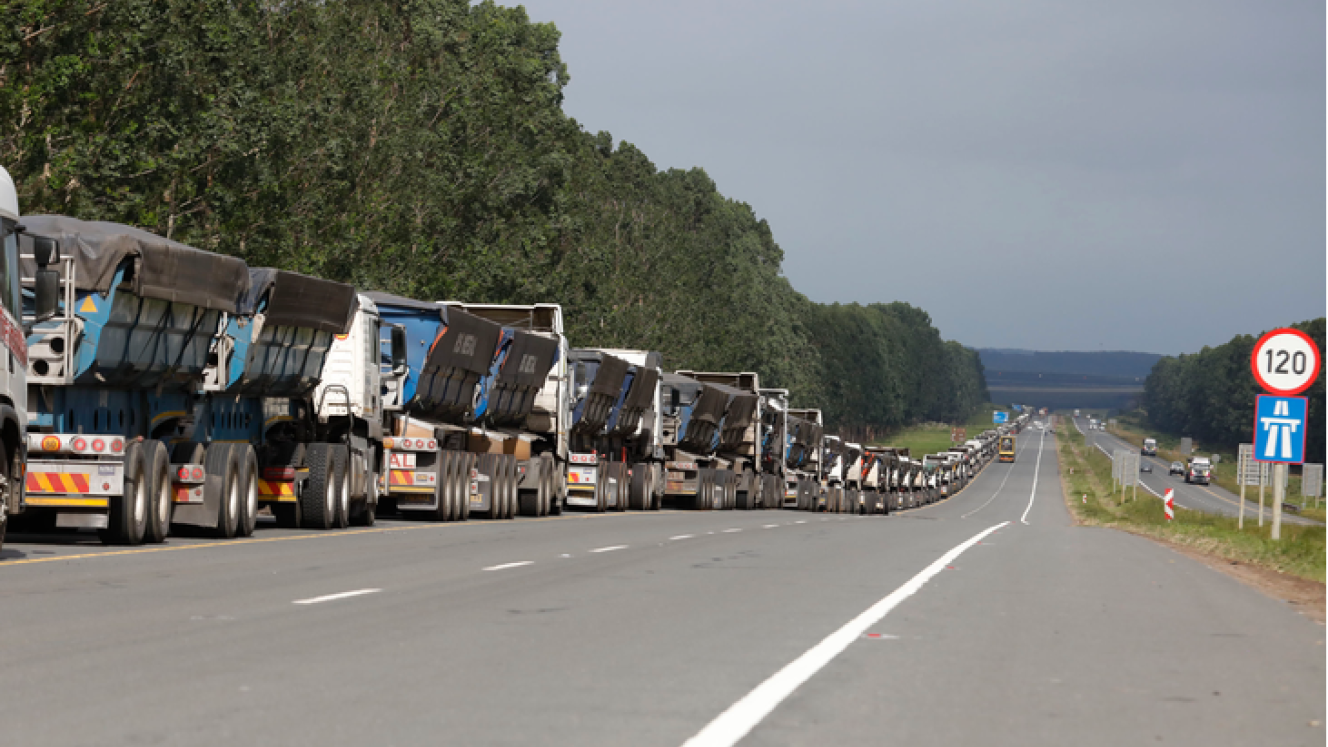
THE DECISION by car carrier Höegh Autoliners to add a Maputo call to its Europe-SA service on a six-month trial basis has sent a strong message to South Africa’s underperforming car terminals. The move – which will see one vessel a month calling at Maputo’s recently-opened car terminal from September to February – will cost the line in the region of $500 000. “We feel that we owe it to our customers who, like ourselves, face similar operational challenges and under-performance from Transnet Port Terminals – and this despite ongoing efforts to try to improve the level of performance with TPT,” Höegh Autoliners’ Africa region MD Per Folkesson told FTW. “Our company has traditionally moved the most volumes in and around South Africa and we have been fairly critical of TPT. As a significant global operator we use a number of monopolyrun terminals around the world but I believe this is amongst the least efficient operations we have experienced from a quality and efficiency point of view,” said Folkesson. “A recent comparative study by the Automotive Industry Development Centre (AIDC) revealed that SA ports were the most expensive in the world – a startling statistic considering the level of service provided.” There has been talk of shipping cars via Maputo for many years – but it’s been the proverbial “chicken and egg” situation with interest but no commitment from the car manufacturers, port and shipping lines. Following the granting of a concession to Grindrod by the Maputo Port Development Company (MPDC), the terminal opened in November last year without any commitment from customers. “This was a significant step,” said Folkesson, “and although we have no firm commitment from customers we feel we have some responsibility to test-drive the port –at least for six months. “If there’s no interest, the train will have gone and the call will be dropped, so it’s up to our customers to act now.” Clearly it’s in no-one’s interests to add a port call – it’s costly in terms of time and money. But a scientific tonnage/volume study undertaken by the line revealed that South Africa’s car terminal facilities did not have the capacity to handle the expected volume growth into the future. “We believe that by supporting the new car terminal we will leverage the competitive situation nicely. Perhaps it will lead to better service and contain tariffs demanded by TPT.” Folkesson does not believe that Maputo will be able to substitute entirely for Durban – although there’s plenty of expansion capacity in phase 2 and phase 3 of its plans. Initially cargo will move to Gauteng by road, and once a one-stop border post is introduced, this will facilitate a smooth traffic flow. For the moment, therefore, Maputo will be used as a complementary port to Durban – and with the port authorities and shipping line having come to the party, it’s now up to cargo owners to add their support.
Höegh to test-drive Maputo car terminal
Comments | 0
© Now Media. This content is protected by copyright and may not be adapted or republished. If you would like to discuss cooperation opportunities, please contact: editor@freightnews.co.za.