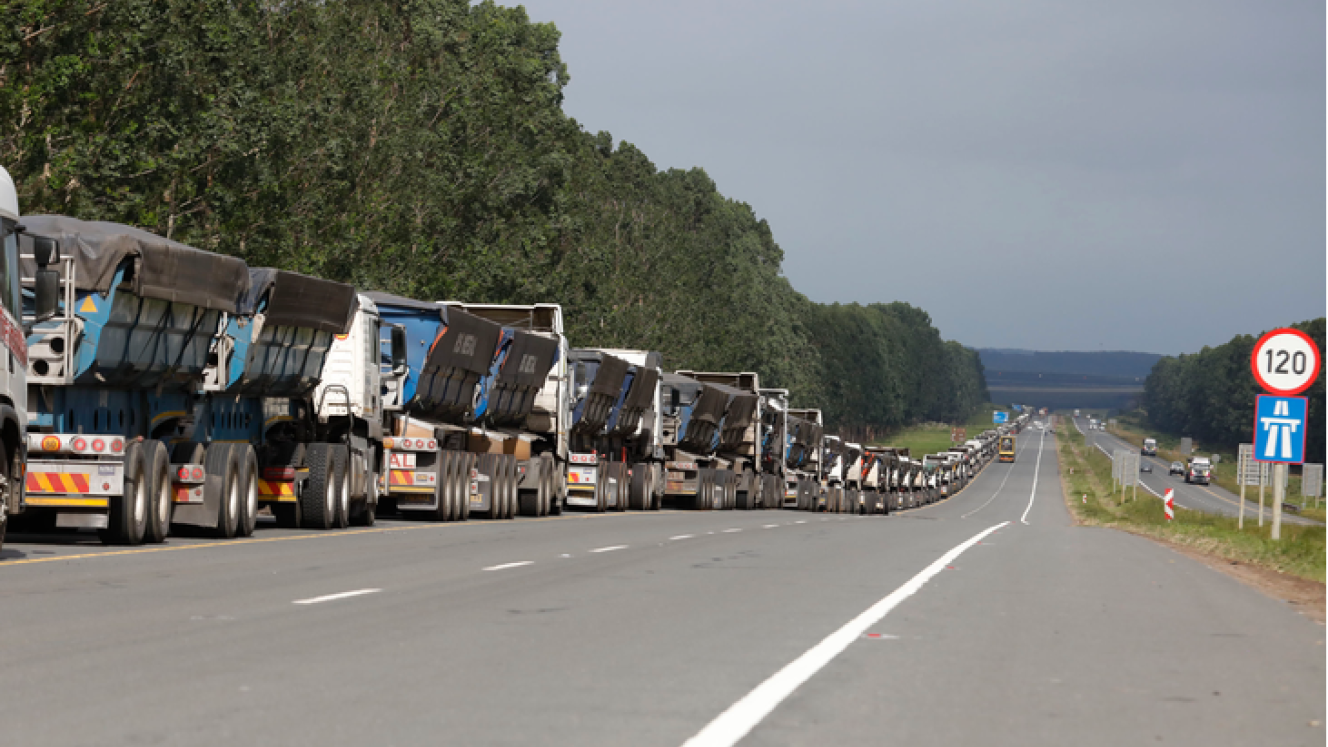
As this issue went to press on Monday morning, the SA Transport and Allied Workers’ Union had applied to the Commission for Conciliation, Mediation and Arbitration for permission to expand the strike to ports and railways. On Sunday (October 7), Transnet issued a statement saying that it had been served with a notice of a strike by Satawu “in a week’s time”. “We are considering the notice and will activate our contingency measures to ensure minimal disruptions should the action materialise,” Transnet’s statement said. Satawu was scheduled to meet again with freight bosses on Tuesday (October 9), but it said the one-day sympathy strike from port and rail workers would forge ahead. The transport strike by 20 000 truck drivers nationwide is now in its third week. The strike action has been marred by violence and intimidation, and companies from various sectors have now declared force majeure because of disrupted supplies due to the truck strike. Oil giant Shell is among these companies, unable to honour its fuel contracts around Johannesburg, while some coal companies and chrome companies also declared force majeure as supplies dried up. There are also fears that Eskom could be left vulnerable if the transport strike continues, especially since some coal companies have already declared force majeure. Some hold-ups in food supply deliveries have also been reported. However, companies have so far been managing, working out alternate delivery routes, but they said constricted truck access had definitely affected everyone. “Everyone is struggling,” David Nel, CEO of Strategic Natural Resources, said. His company owns an anthracite and thermal coal mine in the Eastern Cape. It exports its product through Richards Bay terminal and East London port. “So far the impact from the strike has not been unmanageable, albeit challenging. But if the rumours are true about the strike expanding to ports and rail, then all of this is spiralling out of control,” Nel said. He added that port closures would be damaging to business and South Africa as a whole. However, a possible positive for exporters in South Africa is that the strike turmoil is weakening the rand currency. In general terms this bodes well for exporters, except if industries are completely unable to export. “There’s nothing positive about the flow of imports and exports being under threat,” a producer source said. “If these strikes spread to the ports, South Africa will be crippled. No-one will benefit from this.” Already economists have calculated that the strikes since the start of August – most notably in the mining industry, but also in the automotive and transport sectors – have shaved 1.5% off South Africa’s gross domestic product (GDP) growth. Bulk Connections, the company that manages bulk terminals in the Port of Durban, reported that truck traffic into port had dwindled to less than 50 trucks a day from more than 200 per day before the truck strike. “The trains are still working. So we’ve seen minimal effect,” Iain Geldart, managing director of Bulk Connections, told FTW. However, he said other ports that were more reliant on truck traffic were worse off. The Port of Durban receives coal, iron ore pellets, manganese ore, paper, steel, coils, cars, bulk bags, rice, and so forth, from trucks, although Geldart said most commonly bulk alloys were transported via rail. Transnet did not return calls for comment at the time of publishing. Chrome ore and ferrochrome producers have reported huge delays on their consignments in South Africa. Ruukki’s Mogale Alloys operation, which was about to transport large volumes of plasma charge chrome, declared force majeure on some customer deliveries because of the transport strike. Tata Steel KZN has reportedly cut off ferrochrome production at its Richards Bay plant after struggling to secure chrome ore supply. However, the company denied this. Xstrata Alloys has warned its shipping lines of possible delays, but the company did not expect disruption in deliveries.
High alert as strike action escalates
Comments | 0
© Now Media. This content is protected by copyright and may not be adapted or republished. If you would like to discuss cooperation opportunities, please contact: editor@freightnews.co.za.