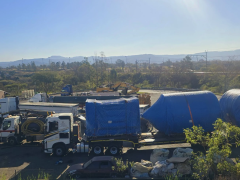
A regional freight company recently played a vital role in relocating 22 black rhino into a Zambian national park. “This was the result of a complicated game swap agreement between SA, Namibia and Zambia,” said Adrian Friend, SA-based MD of Celtic Freight. The company’s Zambian operation was contacted earlier this year by the Frankfurt Zoological Society to assist with one of its projects, he told FTW, which saw the North Luangwa National Park being restocked with the black rhino. “The plan was to airfreight the final five rhinos from Durban,” Friend added, “and heavy rigging equipment and crane trucks were needed at the bush airstrip and boma to offload and relocate the rhino.” This saw Celtic Freight moving rigging equipment, trucks, spares, tools, and workshop staff along dirt roads, river crossings and a steep escarpment into the Luangwa Valley. “On the morning of the move tension mounted amidst the dust and heat, with the SA and British ambassadors having arrived by small aircraft to join the local authorities and dignitaries there to view the spectacle.” News of the successful departure from KwaZulu Natal’s new King Shaka airport of the Safair C130 Hercules with the five rhino on board was passed around, with a planned arrival at 12:30 at the Lubanga airstrip. “The spectacular site of an aircraft that size landing on a tiny dirt strip was something to behold,” Friend said. “Clouds of dust, the noise of the engine brakes, together with the cheering of the crowd, waiting for the arrival of the final rhinos in this ambitious seven-year project.” This was when the rigging and transport job really started – with the crates containing these 1.3-tonne, rather bad-tempered beasts, being slid out of the rear of the aircraft, manhandled to a tractor-pulled trailer, and then rigged on to the waiting trucks to ferry the short distance to the rhinos’ holding bomas. “The rhino experts advised us that it was essential to keep voices to a minimum, to prevent the animals panicking,” said Friend. “The National Geographic film crew on site making a documentary of the whole movement advised that it was the first ‘silent’ rigging operation they had witnessed – with hand signals and facial expressions used to get the job done.” The next morning was the task of getting the rigs back up the Luangwa Escarpment – with chains, winches and a grader all assisting in the fourhour battle over some 50 kilometres. “This was achieved without mishap,” said Friend, “and the trucks, staff and equipment all returned safely to the Lusaka base.”
Heavyweight logistics operation comes up trumps
Comments | 0
© Now Media. This content is protected by copyright and may not be adapted or republished. If you would like to discuss cooperation opportunities, please contact: editor@freightnews.co.za.