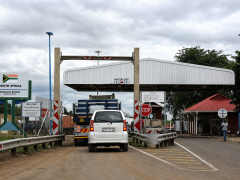
Transporter supplied with wrong info Terry Hutson DURBAN TRAFFIC officials last Friday (January 24) snared their heaviest overload victim yet at Durban’s Bayhead Weighbridge when a truck and trailer were taken off the road registering more than 61% or 29 tonnes beyond the permitted limit. The case has raised questions about who is responsible for overloading containers. The vehicle belongs to Durban carrier Tristar, which claims to do regular work for Safmarine. The haulier was moving two 6m transhipment containers discharged from the Safmarine Memling at the Durban container terminal to Maydon Wharf. Traffic officials told FTW they immediately noticed something was drastically wrong with the vehicle. A closer examination revealed a bent axle and a landing leg bracket supported by string, worn tyres and canvas showing, with one tyre holed on the side. The legal permissible gross mass of the vehicle and trailer was 47 190kgs, but on the scales they measured at 76 200kg, producing a gross overload of 29t. Supporting documents from Safmarine gave the content mass per container as 5 000kg, or a total of 14 600kg with the two containers. “Given this declared mass, the transporter would have been entitled to use a tandem axle trailer, which would have made the overload that much worse. Fortunately he elected to use a triaxle trailer capable of taking a 30t payload, which was double the declared mass,” said Kevin Martin, vice chairman of the Harbour Carriers Association, after he was called to the scene by weighbridge authorities. “From the above it appears the transporter did not intend to load illegally and could in many ways be seen as the innocent victim, except the quality and competency of his driver is a matter of concern. After all, he effectively had a double payload of approximately 60t on his back, whilst the tyres showed clear signs of distress due to this overload.” He pointed out that apart from obvious overload damage to the roads, the vehicle was operating on a public road well outside the vehicle’s design capacity, which includes steering and braking. But, said Martin, for too long transporters have been supplied with either incorrect documents or insufficient information, which is due to ignorance or in some cases is intentional. “No one shipping line or client is to blame, as it is widespread throughout the industry. I stand 100% behind the traffic authorities in this matter and trust the maximum penalty of a R120 000 fine is given because of the serious nature of the offence. Improved correct information of transporters’ documents spells less overload damage to roads, and less dead people.” He maintains the implication of incorrect mass given to shipping lines by their clients, which also endangers the stability of their vessels, is best addressed by the shipping lines.”
Haulier nailed for 29 tonne overload
Comments | 0
© Now Media. This content is protected by copyright and may not be adapted or republished. If you would like to discuss cooperation opportunities, please contact: editor@freightnews.co.za.