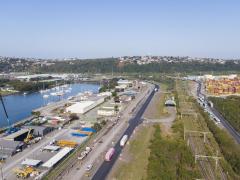
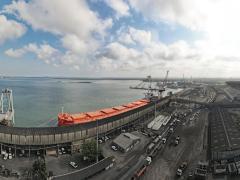
Last week Transnet was busy trying to get some press inches about having concluded the first in a series of early stakeholder engagement sessions with local organisations on the proposed Durban dig-out port project. But these were purely presentations of the prefeasibility plans, said Kevin Martin, chairman of the Durban Harbour Carriers’ Association (DHCA), affiliate of the SA Association of Freight Forwarders (Saaff). “They have been presenting where they are, and where they want to go. However, it’s purely related to the basic construction of the port. When the pre-feasibility is concluded in June, then they will move into the full feasibility study.” And, added Dave Watts, maritime director for Saaff, the series of presentations certainly doesn’t in any way negate the need for hard-nosed discussions amongst all the freight industry sectors to answer the major questions currently doing the rounds in the freight industry in Durban: Should the dig-out port on the old airport site actually be constructed now? If so, would the plan for it to be a full container port be the right one to follow initially? But possibly overshadowing all this at the moment is a study of the port surrounds, commissioned by the eThekwini Municipality and being conducted by Paul Sessions, one of the country’s top transport economists who heads up the municipality’s transport planning department. And it contains some pretty astonishing findings, said Martin, who has just spent a whole day analysing the report. One of these is that all the terminals – Durban container terminals 1&2, the Point, and Maydon Wharf have a total land usage of 218.29 hectares. But the Bayhead rail yard and sheds (mostly underutilised) total an area of 507.2ha. “Why think about the desperate need for a new port when such a huge amount of space at the old port is just going to waste?” asked Martin. And Transnet is absolutely insisting on the need to develop a 60-kilometre, dedicated truck highway connecting up to a Cato Ridge container hub, as a long-term means of reducing the usage of the current road network, including the overcrowded Bayhead Road. But the municipality report found that only 45% of the vehicles on Bayhead Road were container traffic. “They want to move containers to Cato Ridge to reduce road traffic in the port,” said Martin. “But will it achieve that objective if less than half is containerrelated?”
Hard questions must stil be answered over dig-out port plans
Comments | 0
© Now Media. This content is protected by copyright and may not be adapted or republished. If you would like to discuss cooperation opportunities, please contact: editor@freightnews.co.za.