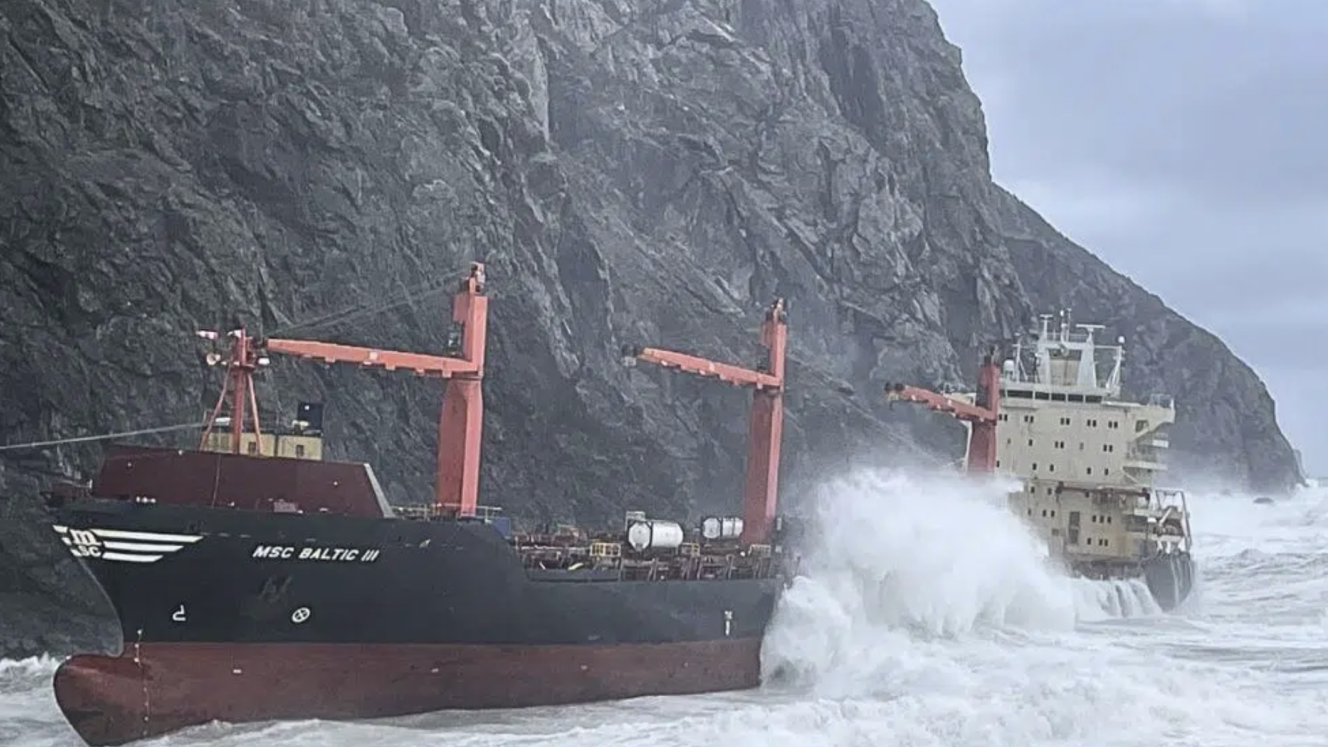
Authorities in Newfoundland and Labrador have signed off on a wreck removal strategy for the grounded Mediterranean Shipping Company owned, MSC Baltic III, confirming that the vessel will be dismantled on site and taken ashore in sections for recycling.
The decision follows months of technical assessments after the ship ran aground in February last year. Alternatives such as refloating or towing the wreck were evaluated but ultimately rejected due to structural damage and the vessel’s prolonged exposure to harsh Atlantic conditions.
Officials said the safest way to deal with the wreck was to break the hull into smaller sections, which would provide greater operational control, and reduce environmental risks.
According to CBS News, a Florida-based company has been tasked with removing the grounded vessel but it is expected to take a year for the area to be restored to the way it looked before the incident.
MSC has contracted Resolve Marine and subcontractors JCL Investments and Newco Metals to conduct the remaining salvage work and removal of the ship.
The Baltic III was grounded in Cedar Cove, near the Newfoundland community of Lark Harbour, when it lost power during a heavy winter storm on February 15, 2025. It was carrying 1 600 to 1 700 tonnes of heavy fuel and marine gas oil as well as commercial and industrial goods in 472 containers. All 20 crew were safely evacuated from the vessel.
According to the Canadian Coast Guard the ship’s hull, port and starboard incurred significant initial damage as well as further damage over the months as it continued to buckle in the ocean. The stern is now resting on the ocean floor.
Todd Schauer, director of projects at Resolve Marine and team lead for the Baltic III salvage work, told CBS News that most pollutants had been removed from the vessel and there were therefore now very limited signs of potential pollution. Some residual fuel, contaminated water and 63 containers remain on board.
He said salvage crews were planning to rip the ship apart at its cracks with heavy cutting chain pullers. Parts of the vessel will be hauled to the beach using specialised systems, fuel tanks will be removed and the ship will be taken for recycling.
The operation is expected to extend over several months, with progress dependent on weather and sea conditions along the exposed coastline. The operation is expected to be completed by the summer of 2027.