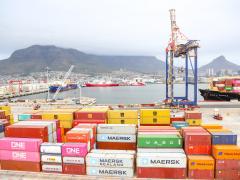
Ray Smuts THE ECONOMIC growth rate of the Western Cape is set to sprint along at 5% this year, 1,5% higher than that predicted for the country by Finance Minister Trevor Manuel, and spurred on by a major new gas find near Saldanha Bay recently. Chris Nissen, president of the Cape Town Regional Chamber of Commerce and Industry, is confident that the ‘Ibhubesi’ gas discovery 300km from Saldanha could be “of North Sea proportions” and have a far-reaching effect on the province’s economy. Official estimates put the reserves at between two and 20 trillion cubic feet compared to between 1,5 and 3 trillion cubic feet of the Kudu gas field off the coast of Namibia. Nissen says if the ‘Ibhubesi’ reserves are somewhere in the middle of the estimates “we could be looking at a project five times the size of Mossgas.” The find was made by the US firm Forest Oil with its South African partners PetroSA and Mvelaphanda, and although yet to be confirmed, a new block south of the ‘Ibhubesi’ field might also yield significant quantities of gas. The gas in the ‘Ibhubesi’ field is trapped in sand and extracting it would entail drilling 300 holes. “This means we will have drilling rigs operating off the West Coast for many years to come.” Nissen says a R13 million feasibility study has been commissioned calling for a floating production platform and a 280km long undersea-pipeline to Saldanha where storage and measurement facilities will be built. The gas would then be piped to Iscor and Namaqua Sands as well as to Cape Town for a gas-fired power station and for general industrial use. Most of the gas would however go to the ‘anchor client’ Mossgas at Mossel Bay in a project costing between R5 billion and R7 billion in total. “As the only industrialised country in Africa we are well placed to become a service hub for the oil industry just as Aberdeen and Singapore have done.” This means that many trading opportunities would exist for Western Cape companies to become major suppliers of commodities as diverse as cement and toothpaste. The challenge for the province, says Nissen, lies in ‘glamorising” the profession of artisans - welders, fitters, boilermakers, electricians and mechanics - given that the average age of artisans currently working in the country is 54 years. Clearly, many more younger people will be required in hard hats in order to rise to the occasion in the years ahead.
Gas find pumps up Cape economic growth expectations
Comments | 0
© Now Media. This content is protected by copyright and may not be adapted or republished. If you would like to discuss cooperation opportunities, please contact: editor@freightnews.co.za.