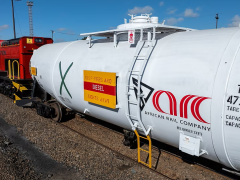
THE ROAD freight industry has had its costs severely battered in the last year, with diesel prices in SA having rocketed by over a third in 2007. The price of high sulphur diesel (0.05 sulphur content) on the coast, according to SA Petroleum Industry Association (Sapia) figures, jumped 32.4% from 537.50cents/litre on January 3, 2007 to 711.50c/l on January 1, 2008. In Gauteng, it rose by 31.6% from 551.10c/l to 725.30c/l. Similarly, low sulphur diesel (0.005 sulphur content) on the coast went up 32.7% from 538.90c/l to 714.90c/l – and 31.9% in Gauteng, from 552.50c/l to 728.70c/l. And, as far as the trucking industry is concerned, the price to look at is that for high sulphur content diesel, according to Kevin Martin, MD of Freightliner and vicechairman of the Durban harbour carriers’ section of the SA Association of Freight Forwarders (Saaff). “Most transporters – long-, medium- and short-haul – are still using 0.05 diesel because it’s cheaper,” he told FTW. “Low sulphur content diesel is used mostly by sophisticated diesel cars. Nobody I know in the freight haulage industry is running with 0.005, because it’s too high-spec, and truckers just can’t justify the higher cost.” And, even with the truckers' volume discounts from suppliers of diesel fuel, the price increase this last year has still been horrendous, according to Paul Rayner, MD of Durban-based container transporters, DTB Cartage. With his company’s discount as a short- to medium-haul carrier, Rayner recorded a fuel price increase of about 29% in the period from January 1, 2007 to January 1 this year. And, although major long-haul carriers get a bigger discount because of their higher fuel volume usage, their percentage increase in the last year is not likely to be much less, according to Martin. This, he told FTW, because short- to medium-haul carriers are running about 3 000- 4 000 kilometres a month and long-haul carriers about four times as much, running about 12 000-15 000 kms/mth. But long-haul trucks tend to run both ways full, whereas a short- to medium-haul trucker is usually running one-way empty. “And it’s when you’re under-load that you burn more diesel,” Martin said, “so long-distance hauliers get fewer kilometres-per-litre for their money.” And FTW’s trucking contacts are in consensus that the fuel element is a major part of a road transporter’s overall running costs. Rayner and Martin both agree that, for short- to medium-haul carriers, the diesel cost is about 25%-30% of the running cost. “For a long-haul operator,” said Martin, “it’s about 35%- 40%.” And that fits in with what Mike Scott of the major longhaul transport company, Cargo Carriers, told FTW. “The diesel price is not controlled,” he said, “and the various users of diesel negotiate their own price with the suppliers – and this varies considerably throughout the industry. “But I’d say that the fuelprice (as a proportion of total running cost) is close to an average of about 32% for the industry generally.”
Fuel burns a hole in hauliers’ pockets
Comments | 0