The International Air Transport Association (lata) and the International Federation of Freight Forwarders Associations (Fiata) are tweaking the new Air Cargo Programme (IFACP) that will lay down the rules for how cargo agents relate to airlines. The aim is to complete it this year. Iata global head of cargo, Glyn Hughes, said the aim of the Global Agency Programme, which it had operated for decades, was to establish the rules for how cargo agents transacted on behalf of air carriers. However, over time, the business relationship between airlines and freight
forwarders had evolved to the point that they now operated less on an agency basis and more as a direct service provider and customer. As a result, Hughes said, the need had arisen to revise the programme rules and management. “Instead of rules being established exclusively by carriers, the rules under the new programme will be jointly developed. Management of the programme would also be under the control of a governing board comprising equally freight forwarders and airlines,” Hughes said.
A pilot of the new programme in Canada in 2017 had been “extremely valuable” as it had shown that both airlines and forwarders had embraced the concept of a new programme developed by the industry for the industry, he added. “Practically it also showed there were some scenarios that weren’t adequately catered for in the new programme so the governing board took this great feedback and has been developing some enhancements to cater for all situations. The programme needs to have equal appeal for small and large forwarders and airlines.” Hughes said the governing board had suspended further pilot roll outs while the feedback was being digested and the programme revised. “It is hoped that a revised and final programme design will be completed during 2019 and a global roll-out plan can be developed,” he said. Hughes added that the benefit of the programme was its shared design that was aligned to today’s business needs and industry relationships.
“This then facilitates the industry collectively focusing on the important issues of industry modernisation, digitalisation and safety and security,” Hughes said. “Replacing something that has been around for so long requires a carefully constructed communication plan and harmonised roll-out programme, so the planning is crucial. People will have questions and we hope the extra time taken to develop the programme will result in universal support and take up,” he said. The IFACP is run by an Iata-Fiata Governance Board (IFGB), comprising senior airline and forwarder representatives. “The pilot revealed certain gaps in the programme with regard to certain cargo tendered to carriers by forwarders on behalf of their shipper customers,” said governance manager Joana Nunes. “The IFGB members embarked on a mission to amend the forwarder agreement to address these gaps in a manner that will involve minimal changes to the programme, reflecting the current business reality between carriers and forwarders without imposing major operational changes,” he said.
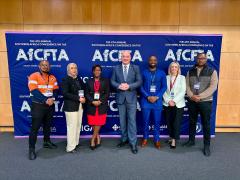
CAPTION: The business relationship between airlines and freight forwarders has evolved. – Glyn Hughes