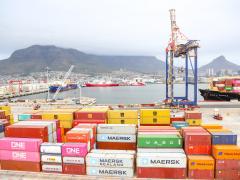
LAST WEEKfS launch by Mitsubishi Heavy Industries of the 7024 TEU Hatsu Shine marked the start of a massive fleet renewal programme by the Evergreen Group. The first in a series of ten S-type container vessels being built for the Group, she will be delivered in September this year and will sail to Europe on her maiden voyage shortly thereafter. The Evergreen Group will take delivery of 18 post-Panamax containerships over the period 2005 to 2008, ten S-types and eight 8000TEU C-types, allowing the Group companies to upgrade existing services and phase out older vessels. The new S-type vessels incorporate many new environmental features that go well beyond the requirements of new and soon-to-be-introduced international requirements. With an overall length of 300 metres and a beam of 42.8 metres, the S-class vessels are able to carry containers 17 rows across on deck and 15 rows across below deck. They have a deadweight of 78 200 tonnes on a service draft of 14.2 metres. SAfs trade agreements in a nutshell THE PROLIFERATION of free and preferential trade agreements between South Africa and a variety of trade partners has opened a host of opportunities in new and previously restricted markets. But keeping pace with developments can be challenging. PricewaterhouseCoopers Customs and International Trade division has produced a useful summary of the current agreements, and how the local industry can benefit. œ Bilateral agreements with Malawi and Zimbabwe. œ A non-reciprocal tariff concession arrangement with Mozambique. œ A Free Trade Agreement (FTA) with 11 of the 14 members of the Southern African Development Community (SADC). œ FTA with the 25-member European Union (EU). œ Membership of the 5-member Southern African Customs Union (SACU). The government is currently pursuing FTAs with China, India, Nigeria and Mercosur. The Generalised System of Preference (GSP) South Africa currently qualifies for GSP preference from 32 developed countries. Traditionally these preferences are in the form of preferential customs duty through the application of reduced or zero rates of customs duties, provided the goods are: œ Eligible and qualify for preferences under any of the GSP schemes; œ Accompanied by a valid Certificate of Origin, a movements certificate or other relevant transport documents; and œ Normally transported directly from the export country to the country providing the GSP, also referred to as the direct transport rule. The precise preferential rate of customs duty applicable to eligible goods will therefore depend on the tariff classification i.e. tariff heading and tariff subheading of those goods and their specific country of origin or the regional country group of origin.
First of Evergreenfs new ships launched
Comments | 0
© Now Media. This content is protected by copyright and may not be adapted or republished. If you would like to discuss cooperation opportunities, please contact: editor@freightnews.co.za.