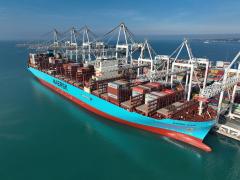
The critical result of misdeclaration on cargo waybills has perhaps been exposed in the more than week-long fire on board the 8 194 TEU container vessel, the Charlotte Maersk, deployed in Maersk Line’s Asia-Europe network. The fire, which took place soon after the ship sailed from Port Klang, Malaysia, saw 150 containers burning at one stage, with the inferno on the vessel’s foredeck reaching as much as 1 000 degrees Celsius.. A total of eight vessels was involved in the firefighting operations as well as a firefighter team leader and seven experts also onboard the vessel, along with a salvage master and a chemist. The process of individually extinguishing the fire in 150 containers was described by Maersk as “surgical extinguishing”. Although there has yet been no official report on the cause of the fire, one publication said that “a container on board the cargo ship exploded about 60 nautical miles off Port Klang, causing a massive fire”. Another publication said that “early reports indicate that the blaze started from a rogue hazardous box”. Hazardous cargo is possibly the greatest fear for shipping lines, and the International Maritime Dangerous Goods (IMDG) code was developed as a uniform international code for the transport of dangerous goods by sea. But FTW readers in the shipping business have asked the questions: “Were HAZ declarations properly made?” and “Who’s negligent here, and who is going to pay the cost of this possibly rogue container?” According to FTW research of an explosion on board the ship Sea Elegance off the coast of KwaZulu Natal seven years ago, a shipper who does not properly declare a shipment of hazardous material as “dangerous cargo” is liable for any damage caused. That explosion was seemingly caused by an undeclared container load of the extremely dangerous pool chemical calcium hypochlorite – which was described by its chemical name on the ship’s manifest. But, said the SA Maritime Safety Authority (Samsa) – which was the investigative team briefed with determining the cause of the shipboard blast which caused a serious fire in the aft section of the ship – “in South Africa, the shipper is liable if he has not clearly indicated that this product is dangerous.” The insurance and claims manager of a major shipping line agreed. “The shipper has to declare to the carrier the hazardous nature of the cargo,” he told FTW, adding that the shipper has got to make known the hazardous code for the cargo – which is contained in the hazardous rule book for each different type of commodity, and describes its potential for explosion, inflammability or the emission of intoxicating gases. But lawyer and marine insurance expert, Andrew Robinson of Deneys Reitz, also suggested that a cargo owner, as the shipper, was unlikely to have suitable liability insurance in place to cover the costs of the aftermath of his container exploding. Standard marine policies exclude this sort of liability,” he said, “only covering damage to the actual cargo shipped by the insured party.” But the issue of liability can get even more complicated. An exception to the above would be where a freight forwarder or any other nonvessel owning common carrier (NVOCC) contracted with the ocean carrier, said Robinson. “It will be more likely that the NVOCC will have some sort of liability insurance. However, that NVOCC will still have to recover from the shipper under the NVOCC bill of lading.”
Fire ignites concern over hazardous cargo misdeclaration
Comments | 0
© Now Media. This content is protected by copyright and may not be adapted or republished. If you would like to discuss cooperation opportunities, please contact: editor@freightnews.co.za.