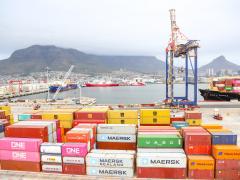
THE NEXT 12 months will be no glory ride, says Safmarine’s senior key account executive Alan Jones. But shipping is a cyclical business and lines are in the business of making long-term commitments in the face of short term realities. And at the heart of these realities is the current high oil price and the impact of interest rate increases in South Africa. “Motor sales are down by 20%, new car repossessions are very high and the local housing market is cooling off fast,” says Jones. “The difficulty with interest rate hikes is that there’s always a lag of 6-9 months, which means we’re now probably only seeing the result of the increases announced in October to December 07. We have yet to see the impact of subsequent hikes so it would be prudent to expect further reductions in import volumes over the next few months.” If the Reserve Bank chooses to maintain the status quo with no further increases to the end of the year, Jones believes we could start to see an improvement early next year. “Imports have dropped by 10-15% in the past three months, varying from trade to trade. “On the Far East route, capacity is available, but exports are starting to overtake imports as a result of the weak rand. And while this is good for South Africa’s balance of payments, it’s not necessarily good in terms of container imbalance,” says Jones. “There’s a huge need in the Far East for raw products – the likes of chrome sand and polymers – and for the first time in several years we’re beginning to see export dominance.” The scenario is not an easy one for shipping lines whose costs are escalating due to the oil price situation – and they are negotiating with an increasingly stretched customer base. “Since there is still great uncertainty as to what the Christmas demand will be, the introduction of peak season surcharges – and their levels – will be dictated by the actual volumes moving. “Rates are based on supply and demand – and that will be individually dictated on each particular trade.” Which gets back to his first point - shipping is cyclical and always has been. “Safmarine is currently building capacity for the next 20-30 years, keeping the fleet under constant review because we are confident the cycle will change into the future. We’re in for the long-term and therefore make long-term decisions. Hopefully we’ll begin to see the turnaround by 2010.”
Exports begin to overtake imports on Far East route
Comments | 0
© Now Media. This content is protected by copyright and may not be adapted or republished. If you would like to discuss cooperation opportunities, please contact: editor@freightnews.co.za.