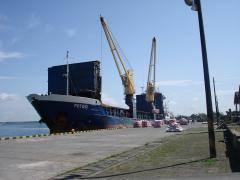
THE SA marine insurance industry is casting a very keen eye on the adverse effects of power outages on the freight industry, and premium increases could be on the horizon, according to Dave Keeling of Underwriting Management Services (UMS) and chairman of the Association of Marine Underwriters of SA (Amusa). “There has been no significant impact up to now,” he told FTW, “but insurance would definitely rise if evidence of higher risk was eventually revealed.” And the areas where the present power emergency can affect the freight chain are many and varied. “Anything that acts as a delay factor has an impact on the cost-efficiency of the industry,”said Keeling, “and could have contrary repercussions for insurance.” There are three aspects, said Keeling – import and export cargoes, and local transit. “Obviously the freight chain for imports would not be directly interrupted by the power outages until they arrive in SA, nor would it for exports after they leave,” he said. “While this would imply that only cargo in transit across SA on its way in-orout of the country could be hit by delays, you have to keep in mind that there are certain indirect aspects which could even hit cargo in its international travels. “The third sensitive area is goods in local transit – like movements from Johannesburg to Pretoria, and not related to either import or export.” Even something as simple as traffic lights not working adversely affects the movement of cargo. “When the lights go out, road traffic flow is disrupted and delays occur,” said Keeling. “Extrapolate it further, and this disturbed traffic flow can lead to more accidents and more damage to cargo – and more insurance claims.” There’s a similar delay factor in rail transport – where traffic signals and lights are electrically powered, and could be rendered inoperative during power outages. Although there has been no major disruption to date, Lawrie Bateman, MD of rail movement specialists MSC Logistics, told FTW that Transnet was very worried about the situation. Power outages could hit them where it hurts, he added, “especially where some of the freight rail movement is hauled by electric locomotives”. Such delays in rail traffic movement could also push up the rate of pilferage, according to Keeling. “Criminal consortia keep a close watch on rail movement,” he said, “and would naturally target trains held up waiting for the power to come back on. “Indeed, for anything pilferable, the longer it lies around – no matter what the transport mode – the more susceptible it is to theft.” Probably the most sensitive area is in the movement of perishable cargoes – any type of product that needs a constantly controlled environment. But even here, according to Keeling, there are only certain points along the freight chain where the cargo could be at increased risk because of power outages. “As long as it’s on its travels, containerised cargo is carried in reefers powered by on-board generators,” he said. “It’s only where it needs to be in cold storage or plugged into power points at the ports that the risk is heightened – and only then when the power outage is long enough to damage the perishable product.” But the risk is still there, he added. There’s also increased risk on the international leg of a cargo’s transit. “If power problems delayed the berthing, or the loading/unloading of a ship for some time, for example,” Keeling said, “export cargoes could get short-shipped, or import cargoes carried back to their foreign departure point, as shipping lines hurry to keep up with their schedules. “That would also push up insurance.” Then there are the more indirect repercussions of national power outages. “Anything that is a just in-time (JIT) import and is delayed could also delay industrial production programmes or the start of projects,” said Keeling. “Even the electronic transfer of documentation or cash being delayed would add another slowdown factor to cargo movement along the freight chain.” There could even be a problem in an underwriter being required to produce those often “last minute” demands for insurance cover, and where in-house power cuts stopped the electronic production of the appropriate documentation. But whether it’s a direct or indirect problem, Keeling insisted that the SA insurance industry was carefully watching its figures – and was ready to react if firm evidence of increased risk was revealed.
Eskom woes could power up insurance premiums
Comments | 0
© Now Media. This content is protected by copyright and may not be adapted or republished. If you would like to discuss cooperation opportunities, please contact: editor@freightnews.co.za.