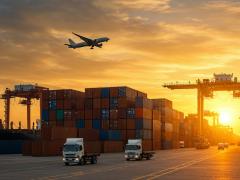
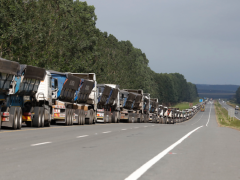
When I was asked to write an article about the issues and challenges that freight forwarders will face over the next ten years, my immediate thought was that given the recent turmoil in economies across the globe, that would be difficult with a time scale of 10 months, let alone 2018! When I considered it more closely, I began to realise that many of the issues and challenges that have faced the industry for time immemorial will still require close attention over the next decade. As the key trade association for British freight forwarders, many of whom have longestablished and profitable business links with exports and imports associated with South Africa, may I take this opportunity to give Freight & Trading Weekly my association’s fullest congratulations on reaching this milestone. I would like to acknowledge the present editor and editors in the past who have worked to keep the freight industry informed in one of Africa’s most complex and significant markets. It is no exaggeration to say that today’s lifestyle and business choices, from Birmingham to Bloemfontein, from Coventry to Cape Town, very much depend on the freight transport business. The new century has seen new questions asked of transport providers that have never been asked before. Consumers, when reaching for the latest must-have item brought many thousands of miles from abroad will, with their next breath, now question the environmental cost of supporting these choices. We are told from many quarters that freight transport is the keystone of the global economy, the glue that binds international trading blocs together. Transport has also been a key player in the growing globalisation and inter-connection of many of the world’s economies in a manner unthinkable just a few decades ago. Transport has never been without a cost but increasingly there is a reckoning that it must face. It is undeniable that transport has a measurable impact on the wider environment which means that transport providers must now begin to face up to the impact that emissions from ships, lorries and aircraft are having. Transport journeys can be calculated in terms of the carbon footprint they leave but, of course, this is only part of the story. Indeed, I consider the entire supply chain is now under greater scrutiny than it has ever been. Many supply chains are now stretched and components for certain products frequently accumulate tens of thousands of miles before they reach the final consumer. Whether this is sustainable in the longer term is a matter of concern and debate. It certainly presents a challenge to transport operators, who will doubtless have to become far more aware of their environmental responsibilities. The transport of food has become an increasingly hot potato for many outside of the transport industry and acts as an interesting case study of many of the dilemmas faced by transport operators. At its most basic, the message is that food produced closest to the consumer is better in terms of carbon footprint than food that must be transported. This concept, which is now widely discussed in the wider media, could adversely impact on demand for perishable foodstuff movements if buyers boycott air freighted or seaborne produce. Transport professionals must work with the food chain to demonstrate that the concept of food miles is too simple an equation. It is worth pointing out, for instance, that a modern containership now uses a fifth of the fuel it required in the 1970s to move a container the same distance and I can also point to the very latest aircraft, both maindeck freighters and bellyhold capacity, that is powered by the most fuel-efficient engines ever. I believe we will experience a growing concern and focus on solving issues such as this over the next few years and much of this will be customer-driven. Bringing about change will rely heavily on the partnership between the cargo owner and the transport provider because each will need to bring their own commitment to the party.
Environmental issues will force change
Comments | 0
© Now Media. This content is protected by copyright and may not be adapted or republished. If you would like to discuss cooperation opportunities, please contact: editor@freightnews.co.za.