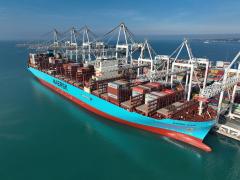
Shipping is by far the most carbon dioxide (CO2) efficient way of moving goods long distances, according to an in-depth emissions study by the major Danish shipping company, Maersk Line. While the fact that maritime shipping accounts for approximately 3.3% of the global CO2 emissions might seem a significant amount – it is still an emission-efficient transport mode, the line told FTW. “For example,” it added, “shipping a pair of shoes from Hong Kong to Rotterdam generates 370- grams of CO2 emissions. This corresponds to driving two kilometres in a modern car.” The difference in CO2 efficiency between different modes of transportation is explained by the emission output being balanced against the economies of scale of a ship’s carrying capacity. The line stated that modern container ships are highly CO2-efficient and may carry 8 000 containers or more. It expressed another argument in favour of its emission-efficiency case. “In addressing CO2 emissions,” said the report, “the whole lifecycle of a product should be considered, and shipping may in fact facilitate goods being produced where it can be done most efficiently – both in terms of CO2 emissions and costs.” Maersk Line – rated the world’s largest container shipping company – described itself as “a key enabler of global trade”. It claimed that it offered a shipping service that assisted its customers in reducing their supply-chain CO2 emissions – and that it was one of the most CO2- efficient shipping companies in the world, claiming to be currently 10% better than the average for the market. “We are constantly striving to become more CO2-efficient,” said the line’s statement. “From 2002-2008 we have cut our CO2 emissions by 15% per container moved, and we intend to our emissions by a further 25% per container moved by 2020. “We improve our efficiency through innovation: Improved ship design, waste-heat recovery systems and development of low-energy, temperaturecontrolled containers are good examples.” In the coming years, the line expected a further move towards reduced supply chain carbon intensity. It listed some of the major external drivers for this decarbonisation. Under the heading of regulation of carbon emissions, the line stated that supply-chain emissions would increasingly be regulated through a variety of policy initiatives. “A new global agreement on mitigating climate change is expected to be settled in the near future,” it said. Looking at high and volatile fuel prices, the line is convinced that a very clear driver of decarbonisation is the link between carbon emissions and energy cost. “It is simply good business to reduce CO2 emissions by lowering fuel consumption,” it said, “and the continued high and volatile fuel prices that are expected in the coming years will further strengthen this drive for decarbonisation of the supply chain.” In its study of consumer carbon awareness, the line noted that there was an evolving consumer demand for products with a low carbon footprint. “For many companies,” it said, “documented action to reduce CO2 emissions will be essential to improve and maintain their reputation in the future.” It felt that these drivers were expected to influence decisions on the way products were produced and transported globally. Maersk Line believes that maritime shipping can play an important role in enabling further decarbonisation of supply chains globally. “And,” it said, “as a leading company within maritime shipping, we are committed to contributing to a lowcarbon future.”
Emission efficient – says Maersk
Comments | 0
© Now Media. This content is protected by copyright and may not be adapted or republished. If you would like to discuss cooperation opportunities, please contact: editor@freightnews.co.za.