Massive
investments in
roads, ports,
airports and rail
– accompanied by the cutting
of red tape – is making it easier
to move cargo in and out of the
main East African markets.
In the lead at present,
according to the PwC Africa
Business Agenda 2017 released
in early May, is Kenya, which is
ranked first choice by African
chief executive officers looking
to expand beyond their home
markets.
South Africa is ranked
second, with Tanzania and
Mozambique joint sixth.
The PwC survey also ranks
Africa’s future megacities (over
10 million people) in terms of
infrastructure, human capital,
economics and demographics.
Nairobi is ranked 7th, Addis
Ababa 9th, Kampala 10th,
Kigali 13th, and Dar es Salaam
15th.
Johannesburg is rated third
after Cairo and Tunis.
These findings support
those of the World Bank’s 2017
Doing Business survey, which
placed Kenya for the second
consecutive year among the
global top 10 improvers.
Ranked 92nd (South Africa
is 74th), Kenya implemented
reforms in five Doing Business
areas.
One of the most important
for the logistics sector is that
it moved up two places in the
“Trading Across Borders”
category, to 105th.
Neighbouring Tanzania
is ranked 180th, but the
government is attempting to
make it easier to use the port of
Dar es Salaam.
Prime Minister Kassim
Majaliwa is reported to
have instructed government
institutions at the port to
operate round the clock seven
days a week.
He was responding at
the 10th Tanzania National
Business Council (TNBC)
meeting to complaints
of inefficiency at the Dar
es Salaam port from the
chairperson of the Tanzania
Truck Owners' Association,
Angelina Ngalula.
She said the dwell time at
the port was 10-13 days which
made it uncompetitive in
the region as its closest rival,
Mombasa, had dwell time of
3-4 days.
The World Bank said in 2015
that inefficiencies at Dar es
Salaam Port cost Tanzania and
its neighbours up to US$2.6
billion a year.
It is
estimated
by the
World Bank
that the
Tanzanian
economy will receive a US$1.8-
bn-a-year boost if Dar es
Salaam achieves the same level
of efficiency as Mombasa.
Things are changing.
In March 2017 work started
on the new World Bankfinanced
Ubungo interchange
which is designed to reduce
congestion on the road.
This follows the
implementation of a World
Bank-funded bus rapid transit
system which is designed to
remove some of the 7 500
daladalas (minibuses) from the
highly congested roads.
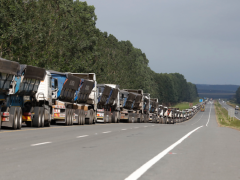
“The journey from the Port
of Dar es Salaam takes a truck
up to seven hours to Kibaha, a
distance of just 28 kilometres,”
Rahim Dossa, a member of
the Tanzania Truck Owners’
Association,
is quoted by
the World
Bank as
saying.
Airfreight
is also being
given a lift with the extension
of the runway and installation
of lights to allow 24-hour
operation by Dar es Salaam’s
Dodoma airport.
Neighbouring countries are
also benefiting from the cutting
of red tape.
According to Dicksons
Kateshumbwa, chairman of the
EAC Committee on Customs,
turnaround time has been
reduced from 21 days to 3-5
days on average between the
entry points to Kampala in
Uganda, Kigali in Rwanda, and
Bujumbura in Burundi.
The six-member EAC is
implementing a number of
customs projects, including the
SCT (single customs territory).
“So far we have rolled out
goods on the SCT on a pilot
basis,” Kateshumbwa told an
April 2017 news conference in
Dar es Salaam.
“However, the most
important decision we
have made today is that
we have agreed on the full
implementation of the SCT
effective July 31, 2017.”
He said customs automation
across the region had been
enhanced in all member states
– Tanzania, Kenya, Uganda,
Rwanda, Burundi and South
Sudan – with upgrades of the
customs systems and migration
to more advanced and robust
systems.
$2.6bn
What inefficiencies at Dar es Salaam
cost Tanzania and neighbours annually.