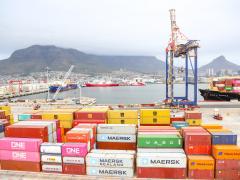
NO GAIN without pain pretty much sums up the scenario facing shippers in the Western Cape over the coming years as the Cape Town container terminal undergoes a R4.2 billion extension designed to increase stacking capacity, but Transnet National Ports Authority (TNPA) remains acutely aware of the need to plan ahead to deal with future demands. As the terminal hovers around the 840 000 teus a year level, more than it can efficiently cope with according to port manager Sanjay Govan, the intention is to increase capacity to 1.4 million teus over the next four years and to two million teus between 2 012 and 2 017. Thirty years down the line – 2 036 – and the terminal will be handling four million teus a year. “At a certain stage a decision will have to be taken on how to address increasing capacity, says port planning manager Billy Cilliers. “If one takes a 3 0-year viewpoint of where containers are going, there is limited capacity in the present port system so where do we facilitate that growth? “We have a period of grace for about ten years but there will have to be a range of solutions, in Cape Town and Saldanha. Alternatively another port or building a new port could be considered, but those studies have not been done.” TNPA is clearly adopting a proactive approach to the capacity problem given that although fewer container vessels are calling, call sizes are larger and will become even more so when 8000-teu container ships become a reality at the terminal’s four berths. These are being deepened to 15.5 metres at a cost of about R1.8 billion. The largest vessels currently calling are of around 4 2 00 teus. Cilliers says 60%-70% is the correct capacity for a container terminal so for Cape Town to be sitting on around 54% a year is not a bad Deepening of port goes ahead … but long-term solutions are a priority Discussing the current terminal upgrade, Cilliers told FTW when TNPA made its original application more than five years ago it had formulated two options. The so-called Plan A involved a 3 00-metre extension out to sea which it regarded as the ideal solution while Plan B involved reconfiguration of existing land. “We wanted Plan A but environmental minister Marthinus van Schalkwyk asked us to do more work. The time that would have gone into that would have impacted and delayed volume growth we are handling so we went for Plan B, which took less time to approve.” Cilliers says that from an efficiency perspective, the out-to-sea plan has always been “the preferred option” and the alternative is a time-saver, not the optimal solution. He makes clear that the out-to-sea concept is still very much alive. “We want to complete the studies Van Schalkwyk requested because we still think it is a feasible option which we would like to pursue in the long term. “What we have simply done now is buy time and capacity but the sort of questions one has to start asking is what happens to capacity in 15 years’ time?”
Deepening of port goes ahead
Comments | 0
© Now Media. This content is protected by copyright and may not be adapted or republished. If you would like to discuss cooperation opportunities, please contact: editor@freightnews.co.za.