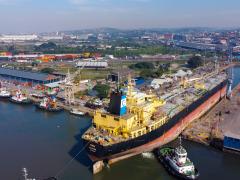
Will the relocation of transhipment containers to other ports help ease the expected overflow of 400 000 TEUs a year at the Durban container terminal (DCT) Pier 2? That’s a question of some considerable speculation amongst FTW contacts in the Durban freight industry. Recently released news indicated that Maersk/ Safmarine was moving container transhipments to the port of Dubai in the United Arab Emirates (UAE) – and this could be added to the move by MSC to shift its transhipments from Durban to the deepwater port of Ngqura in the eastern Cape. This led to estimates being bandied around that over 200 000 TEUs a year might be removed from the overflow because of these two moves. But that’s not the case, John Hyde, Transnet Port Terminals (TPT) assistant terminal executive (planning), told FTW. Mediterranean Shipping Company (MSC), he said, was the port’s largest transhipment customer by far. And its intention to move 100 000 TEUs a year to the new deep-water port of Ngqura in the Eastern Cape, was already taking place. Maersk/Safmarine, he added, was only a small player in Durban’s transhipment business, and any contribution they could make to relieving the overflow would be equally minimal. This was confirmed by Kerry Rosser, Maersk Line’s communications manager. “We are not moving transhipments from Durban to Dubai,” she told FTW, “and the port still remains our hub.” The adjustments the line is making to relieve the overflow, she added, like SA-West Africa transhipments moving to Maydon Wharf rather than DCT, are all small contributions to the total. Hyde also supplied FTW with TPT’s summary of diversion cargo, detailing just how it intended to move the 400 000-TEU overflow away from DCT. Those moving interterminal in Durban will be 150 000 TEUs going to the alternative container terminal at the Point and 60 000 going to Maydon Wharf, for a total of 210 000 TEUs. That leaves a total of 190 000 TEUs that need to be diverted to other ports. TPT plans that 60 000 TEUs of Europe rail cargo will go to Port Elizabeth and Ngqura container terminal (NCT) while the diversion of transhipments to NCT will total 100 000 TEUs (mostly MSC boxes). The remaining 30 000 TEUs of the overflow, Hyde added, will have to be absorbed by berths at Piers 1 and 2. “Maydon Wharf additional capacity only becomes available in September,” he said, “therefore 45 000 TEUs (of the 60 000) needs to be absorbed at existing berths until then. “This means that each of the existing berths needs to absorb 890 TEUs (614 containers) per month until September. Thereafter, only 350 TEUs (250 containers) per month need to be absorbed by each of the existing berths.” Questioned about complaints by the likes of the citrus growers – most of whom are based in Northern Kwa-Zulu Natal and Mpumalanga – about the extra cost of moving reefer boxes of fruit to PE/Ngqura rather than Durban as presently, Hyde said: “A suitable cost offset mechanism is to be in place”. But, despite persistent pressure, he would add no more detail.
DCT outlines plans to cope with 400 000-TEU overflow
Comments | 0
© Now Media. This content is protected by copyright and may not be adapted or republished. If you would like to discuss cooperation opportunities, please contact: editor@freightnews.co.za.