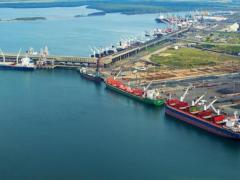
The shipping industry has raised serious concerns about an imminent capacity squeeze at the Durban container terminal (DCT) Pier 2 as the seven new ship-to-shore cranes are installed and berth capacity restricted for six years. This follows a meeting just held between the SA Ship Operators and Agents Association (Saasoa) and Transnet Port Terminals (TPT), with a member of the SA Shippers’ Council (SASC) also in attendance. And the news conveyed by the terminal operator did little to subdue the fears surrounding the on-going loss of a berth, and the 400 000 TEU loss of capacity that DCT Pier 2 will suffer for the six-year period, according to Mervin Webb, purchasing manager for the Hulamin aluminium plant in Pietermaritzburg, a major user of the Port of Durban facilities, and the SASC representative at the meeting. The latest news from TPT was that a Geotech survey of Pier 2 had been completed for installation of the seven new STS cranes ordered. “But the cranes are heavier than anything before,” said Webb, “and the study has revealed that this will lead to instability in the pier foundations, requiring repairs that cannot be delayed.” So, an emergency project will kick off in February next year until December, 2017. This is to stabilise Pier 2 while the quay wall undergoes the installation of the crane rails, and scour protection and berth deepening is also conducted. TPT admitted that it was anticipated that this would lead to a 20% increase in berthing delays while vessel congestion at the outer anchorage was expected to increase and high stack and berth occupancy would be expected. The plan is to divert containerised vessels to the Point’s ro-ro terminal and Maydon Wharf, starting 2012/2013 – which should take up about 60% of lost capacity. The other 40% will have to be moved to Ngqura (NGQ) and Port Elizabeth. But both have problems for the shipping lines. Only two long-haul lines currently call at NGQ – MOL and MSC – and additional calls at either of these ports would be costly in both money and time. Hauling containers from these ports to Gauteng would also mean a landside transportation leg of twice the distance from Durban to the Reef. So it’s problematic for both lines and shippers, according to Webb.
DCT capacity squeeze raises red flags
Comments | 0
© Now Media. This content is protected by copyright and may not be adapted or republished. If you would like to discuss cooperation opportunities, please contact: editor@freightnews.co.za.