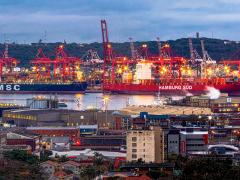
JOY ORLEK FIVE YEARS since concessioning the port of Dar es Salaam has achieved significant operational success, but the financial performance for the port authority has been far from satisfactory in the view of director general of the Tanzanian Harbours Authority, Samson Luhigo. He advised caution at last week’s African Ports & Harbours Congress held at Gallagher Estate in Midrand, urging other port authorities intent on going the concessioning route to make sure that any agreement is comprehensive and covers all bases. He believes that in Tanzania’s case the lessee clearly got the better deal although he concedes that operational performance has been exceptional. Productivity is up from 14 to 23 moves an hour, dwell time is down from 47 to 15 days, and traffic growth has risen from 4% to 15% per annum. Much of this is transhipment traffic, largely won from South Africa’s congested ports. Dar es Salaam was leased in 2000 for a 10-year period on a fixed rental fee with royalties based on TEUs handled. Fuhigo believes that the contract was flawed because it lacked clear objectives. In addition, because of high activity in the east, there was poor tender response at the time. “Most of the risks were borne by the port authority and there was no review mechanism.” These are clearly issues that will be carefully addressed when the concession comes up for renewal. And while there is still limited concrete detail on South Africa’s concessioning plans, there was consensus among all speakers about the urgency of addressing the backlog in infrastructure investment. “Infrastructure development has not kept pace with trade growth,” said National Ports Authority general manager trade and logistics, Nisha Jones. “The focus has mostly been around issues of reduction in tariff and non tariff barriers. And even when transport and logistics were acknowledged as crucial to the competitiveness of nations, ports were seen as points of loading and discharging cargo.” She sees the NPA’s role as that of trade facilitator and improving infrastructure is one part of its mission. “Transport costs in Africa are the highest in the world,” said Captain Khamis Twalib of the Kenya National Committee for Port and Maritime Security. Moving a container from Dar es Salaam to Burundi costs five to six times more than from the US to Africa, he said, an issue that must be addressed from an intermodal perspective. And this holistic approach was echoed by all his fellow speakers who agree that the solution to both port and rail efficiency lies in public/private partnerships.
Dar concessioning has lessons for SA
Comments | 0
© Now Media. This content is protected by copyright and may not be adapted or republished. If you would like to discuss cooperation opportunities, please contact: editor@freightnews.co.za.