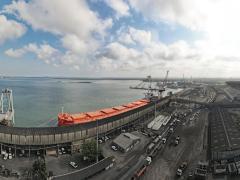
Neighbours’ disunity pushes up costs Kevin Mayhew THE LOGISTICS industry of Namibia is very excited about the possibilities on offer. The completion of the Trans Kalahari and Trans Caprivi Corridors have theoretically opened up greater access to South Africa and other landlocked southern African countries, effectively boosting Namibia’s facilities for exports and imports. But for the country of just under two million inhabitants, the “trans” prefix in the two corridor developments is where the challenge lies – every move it makes requires an unselfish acceptance of its ambitions by one or more of its neighbours through which it must pass to realise its aspirations. The Walvis Bay Corridor Group (WBCG), which is charged with establishing emerging trade routes mainly for trans Atlantic trade into and out of southern Africa for a host of bulk and manufactured products, puts forward a compelling case for using Namibia as an option, but the task is onerous. WBCG business development executive Frank Gschwender puts it quite bluntly: “Walvis Bay offers up to 40% saving in time and costs of transport from Europe into southern Africa. “The port has been improved to handle containers which represent the bulk of through traffic for Namibia and then on to other African markets. We have the capacity to handle what is expected of us when it comes to bulk commodities which include uranium, copper, lead, zinc, magnesium, cadmium, arsenic, pyrites silver and gold, granite, marble, blue sodalite and many semi precious stones.
Cross-border malaise holds back growth aspirations
Comments | 0
© Now Media. This content is protected by copyright and may not be adapted or republished. If you would like to discuss cooperation opportunities, please contact: editor@freightnews.co.za.