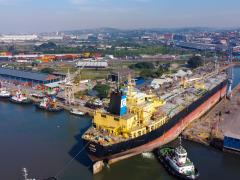
Angola, a travel association once wrote, is a success story in the making – a fascinating, uplifting saga of recovery, renewal, revival and restoration. Civil war has undoubtedly left its mark on the country but it’s pulling out all the stops in its efforts to find its feet. Cracking the Luanda nut so to speak is not an easy feat, says Hannes Rust, managing director of Chavda Freight. “Patience is definitely a virtue when dealing with Angola,” says Rust. “It takes time to establish a footprint and one must have a lot of patience as it is not an overnight process.” The Chavda group of companies has been working in Angola for more than ten years and has become an expert on this resource rich country. “We paid a lot of school fees, but in the long run it definitely was worth it. Taking on Angola requires total commitment as nothing comes easy. There is nothing more rewarding though than seeing the tangible results of one’s work.” Be it food or dairy products, cement or cars, Angola needs it all. “There is a lot of development and construction under way with major efforts by government to improve the non-existent infrastructure. The country needs everything and therein lies many opportunities for business, but it also means you need your own infrastructure in Luanda.” That means either buying or renting property not just for the business but also for employees to stay in when in the country. “We rent a house and a car in the city which makes sense for us as we have developed our Angolan operations and consider it an area of extreme importance to us. It is a niche market that we can serve effectively.” Luanda, says Rust, is expensive, and renting business property does not come cheap. It is advisable to do a lot of research before embarking on a spending spree. “Anyone wanting to start up there should visit the country and start their research in Luanda itself. You cannot make decisions on Angola from afar – you need a presence in the country. A partner is a must for successful business relations.” Chavda doesn’t clear from Luanda due to the major congestion especially at the port. “We mostly use trucks to transport all our goods into Angola due to the congestion at the port. While this has improved, with vessels berthing and offloading within a week instead of the month it usually took, getting containers out of the port can take as long as a month. So for us it is not really a viable option.” He says transporters should take these kinds of delays into consideration along with the bad infrastructure. “In some places the road is all but non-existent and it takes time to move cargo.” While it always helps to have a government contact or two it is not essential when doing business, says Rust – but he advises business people to network as much as possible. “It has been very slow this year so far, but the outlook is positive and we are hoping to see some growth soon.”
Cracking the Luanda nut
Comments | 0
© Now Media. This content is protected by copyright and may not be adapted or republished. If you would like to discuss cooperation opportunities, please contact: editor@freightnews.co.za.