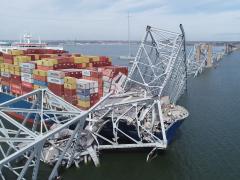
There is no doubt that the curse of overweight containers, and the safety hazard they present, is still plaguing both the shipping and the road transport industries (FTW March 5, 2010). This was probably most strongly highlighted for the SA shipping industry with the grounding of the SA-bound, fully container-laden, MSC Napoli a few years ago. At the time, Christine Barringer, head of the transportation section at the UK’s Health and Safety Executive (HSE), said there were a “shocking” number of misdeclared containers. “The largest single difference was 20-t and the total weight of 137 containers was 312-t heavier than on the manifest.” The only answer, according to many of the lines, MSC included, was to introduce a misdeclaration penalty fee – hoping that this would force shippers to focus on declaring correct container weights. But Alex de Bruyn, Safmarine SA trades executive, suggested that a carrot rather than a stick solution might be a better idea. “I believe the answer to the problem of misdeclared containers lies primarily in market education – making everyone more aware of the cost and safety implications of overloading containers.” And he summarised just what this all means for shipping lines. “Firstly, not only do misdeclared containers present problems in terms of the planning of vessels but, more importantly, overloaded and overweight containers pose a serious threat to the safety of crew and vessels as they can affect the stability of a ship.” You can add to that the fact that shipping lines use the weights declared by shippers on the shipping instruction (SI) to determine the maximum amount of cargo that can be accepted for a voyage, and to optimise the revenue for that voyage. “In other words, how much cargo we can load before we reach the required deadweight limits (while also taking into consideration the weight of fuel, stores etc).” But the lines have to make a bit of a guesstimate in these calculations. “If shipping lines have reason to ‘mistrust’ the information which is provided by shippers, they will compensate accordingly – always erring on the side of caution. “In other words, lines will assume container weights are higher than declared and, in the interests of safety of crew and vessel, load fewer boxes than can actually be accommodated. While the decision may be made in the interests of safety, the cost consequences of ‘short-loading’ a ship are far-reaching and impact the shipper in the end.” That’s on the seaside, but there’s a similar problem landside, which De Bruyn noted as his third consideration. “This is the danger overloaded containers pose to road users and the negative impact they have on road infrastructure.” And road users also recognise the mutual problem that misdeclared containers cause for them and for the shipping lines. Said Kevin Martin, vicechairman of the Durban harbour carriers’ section of Saaff: “It is impacting on their bottom lines – with over-declarations resulting in them cutting-and-running, and leaving containers behind because the vessel is apparently full. And then with under-declaring resulting in badly loaded, unstable vessels.”
Cost implications of overweight containers spelt out
Comments | 0
© Now Media. This content is protected by copyright and may not be adapted or republished. If you would like to discuss cooperation opportunities, please contact: editor@freightnews.co.za.