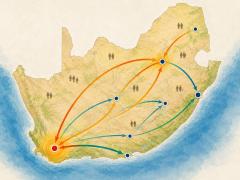
FTW: What is the background to the corridor strategy – why is it so important, what was the motivation and what are the important issues involved? TPT: Part of the Transnet growth strategy is to adopt a corridor approach for key commodity flows – the objective is to remove bottlenecks and inefficiencies from the corridor to maximise throughput. FTW: Integration between port and rail appear to be a key ingredient – your comments on how this will be achieved. What are the challenges, what progress has been made? TPT: Integration between customer, port and rail is critical – long-term expansion plans, daily planning and operations, maintenance shutdowns etc all need to be fully aligned to ensure the corridor runs as efficiently as possible. The Sishen to Saldanha corridor (iron ore) has been managed as a corridor for the past few years and has proved to be successful – in April 2009 a new record of 4.5 million tons was exported. The Richards Bay corridor GM, Graham Braby, has only been in place for a few months but we have already seen the improvement in coal export operations. FTW: Is the corridor strategy based on overseas models? TPT: There are numerous examples overseas where the mine, the rail link and the port operation are all owned by one company which results in natural alignment, with all three legs working towards the same objective. In some cases the entire infrastructure is dedicated to the single product of the applicable mine. In South Africa our primary corridors are complex in that numerous train configurations are needed to transport different products and passengers on the same line. It is within this complex environment that the corridor teams are seeking to improve efficiency by focusing on the end-to-end process of specific commodity flows. FTW: To what extent are your plans informed by the needs of stakeholders – how are they involved in the process? TPT: Our plans need to be fully aligned with the needs of stakeholders and achievement of this is part of our role. The efficiency of mine operations and their load-out stations has a direct impact on Transnet operations and vice versa. Most of the expansion programmes in this industry require a lead time of years so it is imperative that planning for port, rail and customers is fully aligned. FTW: Your priorities in your new position – the immediate challenges. What are the first steps in the process? TPT: We are presently in the process of recruiting the corridor teams. We are focusing on four primary corridors: RBayCor (Coal fields to Richards Bay) NatCor (Gauteng to Durban) CapeCor (Gauteng to Cape Town) Sishen (Sishen to Saldanha Bay) Key commodity flows are export coal, domestic coal, iron ore, container traffic on rail The teams’ key focus is to ensure a coordinated approach to planning, investment and operational strategies within each corridor. This requires alignment between Transnet’s operating divisions and the requirements of customers utilising the channel. The teams will track volume flows from source through to the port for export and vice versa, unlocking bottlenecks and creating a culture of continuous improvement in the system.
Corridor strategy will align with stakeholder needs
Comments | 0
© Now Media. This content is protected by copyright and may not be adapted or republished. If you would like to discuss cooperation opportunities, please contact: editor@freightnews.co.za.