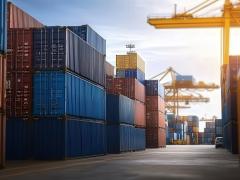
The shortage of empty containers is reaching critical levels – with the Far East screaming out for empty boxes to ship out ever-growing volumes of exports. Not only is trade continuing to gather steam after the recent recession, but the northern hemisphere summer peak season is well under way and the southern hemisphere pre-Christmas rush starts accelerating from next month (July) through to end- November. Shippers are already facing substantial peak season surcharges as capacity tightens on both the Asia-Europe and trans-Pacific trades – with the ongoing practice of slow-steaming meaning that there are more containers on the water on both these main trades. A major ship’s agency on the Far East sea trade told FTW that they were shipping boxes back to the orient “as fast as possible”. Also, Iain McIntosh, the marketing manager of Mitsui OSK Line, said the local business was “under real pressure” to return boxes to their Japanese home base. “There is certainly a massive upturn in the usage of equipment in the Far East,” he added, “particularly in China.” Ivan Naik, MD of Pacific International Line (PIL) in SA, agreed. “We’ve had to reposition a higher volume than normal,” he told FTW. Right now there is certainly some availability of empties, with Lindsey Heynes of Grindrod Intermodal saying: “We’ve watched the levels dropping from last year, when you couldn’t move about the place. But we still have a little bit of stock.” She suggested that a number of the Chinese container manufacturing companies which had closed down during the recession had restarted, but didn’t reckon that this extra supply of new boxes would be enough to overcome the current dearth of equipment. As SA is moving into peak season gear, she expects to be short in about a month’s time. “And,” she added, “when you speak to the container leasing companies, they say that they reckon on a serious shortage building up over the next two to three months.” Rhett van Zyl, the Durbanbased MD of CMA CGM Shipping Agency, noted that the shipping lines had tightened up on their equipment replacement programmes during the recession. “A lot of lines sold off their older containers and stopped making new purchases,” he said. But the resurgence in trade volumes has been faster and greater than many expected. He therefore agreed that there was a growing global shortage. But, on the local scene, CMA CGM was still continuing to reposition boxes from West Africa, and the line didn’t have a shortage at the moment. But, on the global scene, it’s crisis-time in the shortage of available containers in Asia. So much so that the world’s number one container carrier, Maersk Line, has been bringing in laid-up ships to ferry containers to Asia in an attempt to address the box shortage that is set to hamper the industry during the peak season. The Danish carrier said it had re-activated laid-up vessels to assist in repositioning containers as quickly as possible. It has also kick-started production of new containers and leasing of containers. Board member Lars Reno Jakobsen, head of network and product, said: “The present market situation is unique. We are experiencing a demand surge in most trades, which is a development that is both unprecedented and unexpected by us and our customers. “For example, the Asia- Europe trade is growing by 23%, compared with the market’s single-digit expectation just six months ago. “Therefore, we already see a very tight equipment situation. And we expect an even more pronounced and serious shortage of containers in the coming months.” And, because of the extra costs associated with combating the container shortage, Maersk announced a record peak-season surcharge (PSS) on the Asia-Europe trade. The trade publication, IFW, also reported that world number three, CMA CGM, was also attempting to introduce equipment repositioning surcharges. It quoted CMA CGM senior vice-president Asia-Europe Nicolas Sartini, who said that the volumes experienced by shipping lines so far this year had been “a little bit incredible”. He expected demand to remain strong over the next three months and as a result he believes there is a risk that vessel space “could be tight” in the third quarter. He also said the industry could be faced with an equipment shortage. He said: “In terms of container availability, we are starting to see the impact of slow-steaming. It takes more time to bring back the equipment to Asia from Europe and the US, on any trade. “Secondly, because of the difficulty in accessing credit for financing, there was a lack of container ordering in 2009, and also this year. “The lines are faced with very strong demand and difficulty in getting efficient equipment in time.” As a result of the increased volumes, he expected to see a “correction” in rates in July, when second-quarter rates expire and carriers start to implement peak-season surcharges. CMA CGM has announced a third-quarter rate increase on the Asia- Europe trade of US$250 per TEU and it will implement a peak season surcharge of US$200 per TEU with two weeks’ notice.
Container shortage hits critical levels
Comments | 0
© Now Media. This content is protected by copyright and may not be adapted or republished. If you would like to discuss cooperation opportunities, please contact: editor@freightnews.co.za.