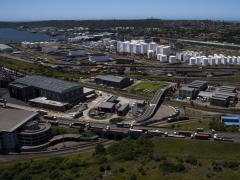
Framework for concessioning still awaited Soldiering on - the framework under which concessioning will take place is still awaited. Alan Peat THE MOVE towards concessioning the container terminals in the SA port network is still wending a rather weary path towards finalisation - but still with the threat of union action if the present privatisation course is steered. Two issues have recently taken the spotlight. First is SA Port Operations (Sapo) chief Themba Gwala telling the press that Sapo intends to go ahead with its plans to restructure the present container facilities in Durban regardless of whether there is concessioning or not. This, according to Dave Rennie, CE of United African Container Line (formerly Unifeeder and Unicorn) and chairman of the Container Liner Operators Forum (Clof), involves two developments. First is the addition of the three Italian-sourced gantry cranes due at the Durban container terminal (DCT) this year, and the three of South American origin due in place next year. “This will bring the complement of cranes up to 19.” At the same time, the present fleet of 60 straddle carriers should go most of the way to servicing this number of cranes - although it might need one or two more. “The other expected development is the MPT West addition to Durban’s container terminal needs,” Rennie said, “converting Pier 1 into another dedicated container facility.” Rennie also commented on the recent FTW story that - in choosing the concessionaire - a consortium rather than a single concessionaire was the likely scenario. This, he said, in no way precluded the concession being granted to an international port operating company. It rather referred to the need for a black empowerment element to be involved in the final company chosen. “However the framework under which concessioning will take place is still awaited,” he said. “This, and the union issue, have to be solved before the request for qualification (RFQ) will be issued.” He certainly expected something to be finalised this year. “It’s imperative they get it right,” Rennie said, “because if they don’t it will have a general impact on the SA economy as a whole.”
Concessioning crawls to finality
Comments | 0
© Now Media. This content is protected by copyright and may not be adapted or republished. If you would like to discuss cooperation opportunities, please contact: editor@freightnews.co.za.