Growing competition between ports in southern Africa is changing the trading landscape. FTW’s Africa correspondent, Ed Richardson, provides an update on the many alternatives to traditional routes.
There is major work being done or planned for all of the ports serving Southern Africa, with the exception of those that fall under Transnet, which has recently completed an investment cycle. It is estimated that round 95% of all trade to the region passes through ports from Dar es Salaam on the eastern seaboard to Luanda in the west.
Competition between the ports is growing, with cargo owners and freight forwarders being forced to look at alternatives to historic routes in order to save costs on the total logistics chain. These costs include interest paid on high-value goods in transit – a factor which is helping ports like Walvis Bay and Beira to become more competitive.
Another factor driving competition is that some governments have entered into public private partnerships to run their port facilities. Managers of companies with shareholders are more focused on profit than those heading up parastatals.
Dar es Salaam – aiming for 19000-TEU vessels
The capacity of the Port of Dar es Salaam will be increased to 25 million tons over the next seven years following the World Bank board of executive directors’ approval of a $345-million credit and a $12-million grant to the new Dar es Salaam Maritime Gateway Project (DSMGP).
Soon after the approval of the credit line the Tanzania Ports Authority (TPA) signed a 36-month contract of US$154 million with state-owned China Harbour Engineering Company Limited (CHEC) to build a roll-on, roll-off (ro-ro) terminal and deepen berths one to seven from 8-15 metres, allowing the port to accommodate 19 000 TEU vessels.
The investments in the Port will also improve waiting time to berth from 80 hours to 30 hours as well as overall productivity.
The DSMGP is part of a larger ongoing multimodal investment programme for the port of Dar es Salaam. The Government of Tanzania is contributing about US$63 million through TPA, while TradeMark East Africa is supporting the rehabilitation of access and egress roads and demolition and relocation of sheds. The United Kingdom through its Department for International Development (DFID) is contributing a $12 million Grant.
CAPTION
Capacity to be increased to 25 million tons over the next seven years.
Nacala – significant rail investment
Nacala is the only port with significant rail investment. Managed by private Mozambican company Portos do Norte, it is being developed primarily as a rail-fed port for both bulk coal and containers.
The African Development Bank has provided a US$300- million loan for the US$5- billion Nacala corridor rail and port project.
It connects the hinterland with a 912-kilometre rail link from Tete province in western Mozambique to Nacala through Malawi. Upgrades to the port include a coal terminal, which has been operational since January 2016. Dredging has started to make way for a new container terminal with a drought of 14 metres, and with a 400- metre quay wall. The project is being financed through a loan from Japan.
The project anticipates four million tons a year of freight capacity for non-coal commodities as well as opening up regional agricultural producers to world markets.
A recent study by Jica (Japanese International Cooperation Agency) found that the cost of transporting cargo to and from the port of Nacala to Blantyre in Malawi was 78% lower than using Beira, 40% less expensive than Dar es Salaam and 39% cheaper than Durban.
Beira – new coal terminal on the cards
A gap was created by Vale shifting its coal exports from Beira to Nacala for the Indian Essar group to build a new coal terminal in the Beira port precinct.
Essar Ports has signed a 30-year concession agreement with the Mozambican government to develop the Beira coal terminal as a Public Private Partnership (PPP) project.
The container and breakbulk terminals are operated by Cornelder de Moçambique (CdM), which has made significant investments in the port, including the implementation of Navis N4, to allow for growth beyond the current 200 000 TEUs a year.
After completion of a new entrance for trucks, CdM is planning to upgrade the existing terminal exit to install a covered inspection area and bring its capacity to 750 000 TEUs.
Durban – investment put on ice
Investment in South African ports has been put on ice, with Transnet focusing on expanding its rail and pipeline capacity by 33% and 97% respectively, according to the 2018 budget review.
Durban is, however, recovering from severe congestion, according to Transnet Port Terminals general manager Julani Dube.
According to Dube Durban set a new record of 190 000 TEUs in February 2018, a 57% improvement in shift change, an increase to 75.5 ship working hours and 4 000 trucks handled in one day – compared with the previous average of 2 500.
The terminal has a combined capacity of 3.6 million TEUs per annum, which will increase to 4 million TEUs after berth extension.
Work is in progress to deepen terminal draught to 16m. Established in July 1977, the Durban Container Terminal operates as two terminals Pier 1 and Pier 2, handling 65% of South Africa’s container volumes.
CAPTION
Record 190 000 TEUs handled in February
Maputo – aiming for 250 000 TEUs
The Maputo Port Development Company (MPDC) has invested US$800 million since 2003 to increase the capacity and efficiency of the port, which currently processes 40 million tons of cargo.
A number of investments have been attracted by the dredging of the port to 14.3 metres, according to MPDC chief executive officer Osorio Lucas.
These include upgrades to the Matola Coal Terminal (TCM), and an open storage dry bulk terminal handling coal and magnetite.
In 2017, the DP World Maputo Container Terminal began expansion work to increase capacity from 150 000 to 250 000 TEUs.
Maputo is also gearing up to receive even deeper draught vessels, with the reworking of berths 6, 7, 8 and 9 – a total 1 058 metres of quay – due to begin in the second quarter. Rail freight volumes have grown in recent years due a joint strategy between the port and the Mozambican rail operator CFM.
The volume of chrome and ferrochrome carried by rail almost doubled from 411 000 tonnes in 2016 to nearly 1m in 2017.
Ngqura – manganese terminal set for 2023
The Ngqura Container Terminal (NCT) has been designed as a transhipment hub, “servicing traffic from the East, South America, and West African markets,” according to the TPT website.
There are plans for a manganese terminal, with the ever-shifting date now set for 2023. In the meantime, the bulk jetty is used for rig repairs.
Transnet has plans to upgrade the rail line from the manganese mines in the Northern Cape to Ngqura, but has not announced any for the upgrading of the freight link between Gauteng and Ngqura.
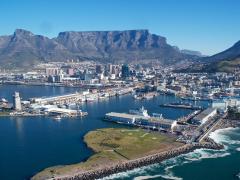
Cape Town – set for 1.4-m TEU capacity
Transnet has invested substantially in a multi-phased terminal upgrade plan for Cape Town, with Phase 1 having been completed. This includes extending the quay wall by 10m over the entire 1137m length of the quay, at a depth of 15.5m.
Phase 2 will increase capacity from 1 million to 1.4 million TEUs. The upgrade includes the installation of 2 700 reefer plug points, to bring the total to 3 752.
The first upgrade has allowed the terminal to receive and service 8 000- TEU vessels, 19 containers stacked across and eight high on deck.
CAPTION
The upgrade includes the installation of 2 700 reefer plug points.
Lüderitz – plans for new deep-water port
Namport has invested in a new 500m quay, two 60-ton haulers and one 45-tonne reach stacker to improve capacity. There are also plans to build a new deep-water port at Angra Point, which has a natural draught of between 16 and 18 metres, compared to the present draught of 8.75 metres.
Walvis Bay – container terminal 76% complete
Walvis Bay’s new container terminal is over 76% complete, with most of the work due to be completed in 2018. The new terminal will be able to handle 750 000 TEUs a year, compared to the current capacity of 350 000 TEUs. Work has also started on an SADC bulk port.
CAPTION
The new terminal will be able to handle 750 000 TEUs a year.
Luanda – prospects limited
The port of Luanda has been modernised, but future prospects are limited due to the growth of the city around it.
At present the port handles around 70% of Angolan imports and exports, although traffic is well down on the high of over a million TEUs in 2014.
Work has started on a new deep-sea port in the northern Cabinda province. According to a media release, the Port of Caio will commence full operations in the first quarter of 2019, one year ahead of the original schedule.
Lobito – courting copper and cobalt exports
Soportos has taken over management of the minerals terminal, while Sogester (a consortium consisting of APM Terminals and local partners) has won a 25-year concession for the container terminal and dry dock at the Port of Lobito.
Both companies already operate similar facilities in the Port of Luanda. In 2015 the historic 1 344 km Benguela rail link between Lobito and the Copperbelt in the Democratic Republic of Congo was completed up to the border between the two countries.
Uptake has, however, been slow, with the first cargo from the DRC leaving by train on March 6 this year. The 50-wagon train left from the border town of Dilolo in southeastern DRC.
Ikos Rukal, spokesperson for the provincial government of Lualaba, where Dilolo is located, said the 1 300km Dilolo-Lobito route was “the most cost-effective form of transport” for exporting copper and cobalt from DRC’s southern mining belt.
Plans for the rebuilding of the Zambian rail link were given a boost in October 2017 when the Zambian cabinet approved a 30% stake in the North-West Railway company, which is responsible for rebuilding the line.