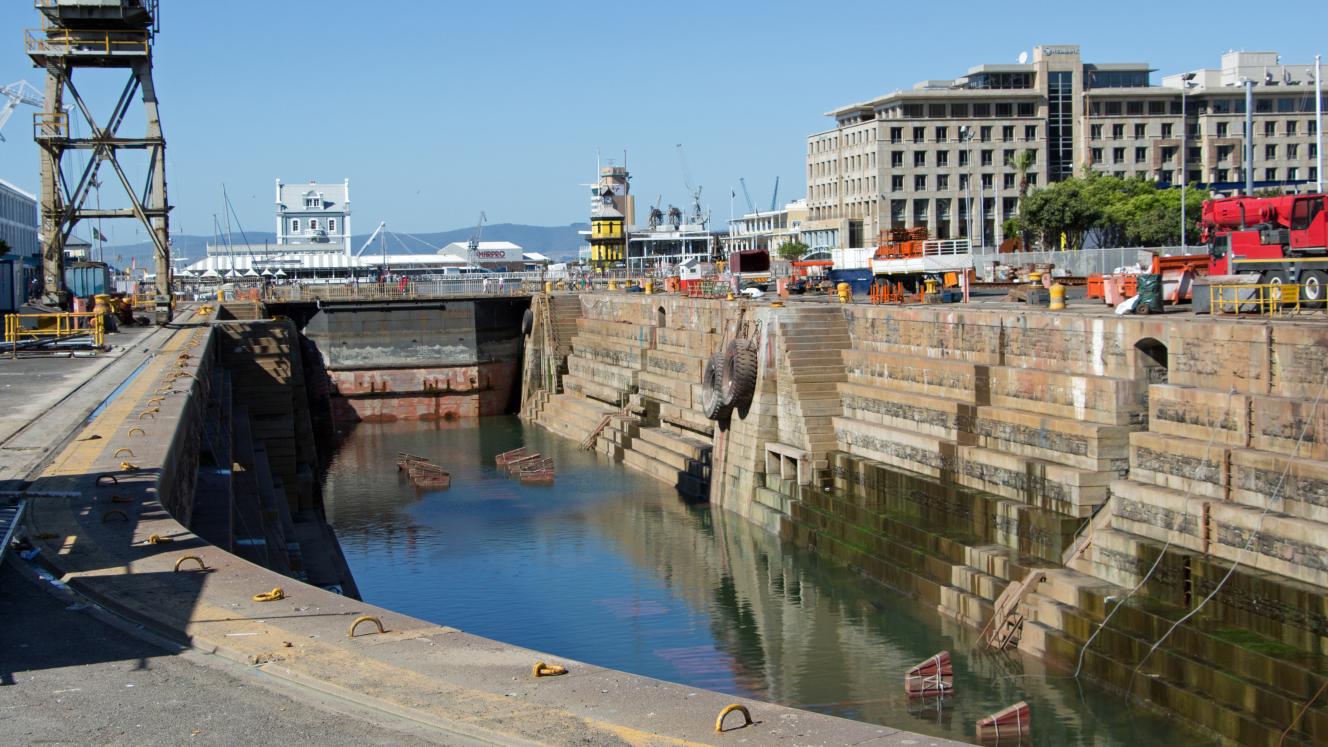
TRANSNET’S original plan to reclaim land from sea to create muchneeded capacity at Cape Town container terminal is by no means dead and buried, despite its axing by government. This was made clear last week by Billy Cilliers, port planning manager, and endorsed by port manager, Sanjay Govan, at Transnet National Ports Authority’s first container terminal capacity briefing for customers. Cilliers, in a detailed presentation of dramatic new developments over the next few years, stressed forward thinking was essential to meet growing container needs ten years down the line. “The work does not stop here. We have to start looking at new basins and launching environmental impact (EIA) assessments now, already.” Even though environmental minister Marthinus van Schalkwyk bowed to environmental concerns by rejecting the 300-metre ‘out-to-sea’ plan, on which planning first started in 1999, Transnet thinking is clearly that this is the only way to go for the future, though it will no doubt once again be dogged by environmental appeals and delays of one kind or another. TNPA CE Khomotso Phihlela indeed acknowledged in his welcome that the development about to be implemented, the so-called ‘Plan B’, was not ideally what was sought at the outset. Referring to the tremendous global growth in containers, he said it was between 6% and 8% in the US, 22% in Korea and more like 15% in South Africa, whereas initial thinking pointed to between 8% and 10%. Cilliers said the new development was threetiered. First it needed to sustain existing business, second to cater for future growth up to 2012 and third – and yet to be approved – to swell capacity reconfiguration up to 2 million teus between 2012 and 2017. In the shorter term, over the next four years, stacking capacity will be increased from between 700 000 teus and 800 000 teus a year to 1.4 million teus. The first tenders for construction have been awarded to a consortium of WHBO and a local company, Civil and Coastal, which have in turn subcontracted Danish company, Rhode Nielsen, to undertake dredging the terminal from 14 metres to 15.5 metres, starting with berth 601 and ending with 604 by 2011. This will involve moving 1.23 million cubes of sand, clay and rock from Ben Schoeman Dock and dumping it off the Atlantic Seaboard in water up to 70 metres deep. Another new disclosure is that the move toward rubber-tyre gantries, able to stack higher than straddle carriers, which are to be phased out, entails acquiring 32 units at around R1.4 million each. This is budgeted for in Transnet’s R4.2 billion spend for the development, which also includes eight new L iebherr post panamax ship-to-shore cranes. These are able to work in wind speeds of up to 100km/h, unlike the existing old Demags and Noels, which are only able to cope with speeds of 80km/h. The aim, says Cilliers, is to undertake the development with the minimum of disruption. The multi-purpose terminal is geared to handle around 100 000 teus of containerised cargo and will also accommodate smaller containerships if necessary, once construction gets under way at berth 601. Two shipping lines have already expressed interest in using the MPT’s facilities.
Cape Town spells out bold new expansion plans
Comments | 0