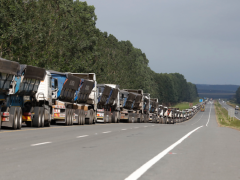
Finding sufficient equipment to service South Africa’s booming renewable energy projects sector is becoming increasingly difficult. According to Eugene Yntema, project manager for ALE Heavy Lift South Africa, while there is no dire shortage as yet, this is a very real possibility in the near future as more projects take off. “Sites are remote and often 580-800km from a port – and the rate of delivery is two turbines per week. That translates into between eight and ten abnormal loads and around 15 other loads a week. So at any given time some four abnormal loads are running at the same time,” he explained to FTW on the sidelines of the Breakbulk Africa conference in Johannesburg recently. “It requires a massive capital investment from operators in this arena to be able to supply equipment at that rate. At the same time it is an intense business where everyone is pushing price and the requirement is to perform, perform, perform.” Yntema said in 18 months ALE had delivered 252 turbines. “One is constantly under pressure to deliver in this high-volume, timeconstrained environment.” He said purchasing, maintaining and operating trucks and trailers was a priority for most transporters who also had to invest in driver and staff training. “Anyone entering the renewable project sector will have to invest heavily in their fleet and staff. The capital that one is investing is large so there has to be certainty that you are going to get a guarantee on this investment.” He said in uncertain economic times it was a difficult operating environment. “Often the logistics service providers are taking a leap of faith that they will get more work, but that is asking a lot of our industry. To take part in the wind business you have to be able to handle large volumes swiftly – and the only way to do that is to have lots of equipment in place and that does not come cheap.” Equipment shortages are already being felt at times, he said. “There is a shortage of assets on the ground as there is not enough equipment. At the moment also there is a race to get to projects and it becomes very difficult to prioritise what projects gets the necessary equipment first.” He said with very little resources available to improve the situation planning was a key element to ensure success. “We are all falling back on planning to ensure we are able to move cargo all the time. It also means collaborating more with stakeholders and service providers and trying to stay ahead of the schedule because if one falls behind it is near impossible to catch up.” At the same time it is important not to take shortcuts, says Philip Warren, managing director of African Route Clearance. “There is immense pressure on companies to service this sector due to the insufficient number of axle lines in the country at present – a situation that will undoubtedly be exacerbated as the projects increase. The problem is further compounded by the delays experienced at ports and in the transport of the cargo – and one finds more and more that shortcuts are taken which is a recipe for disaster.” Warren warns against risky equipment saying it compromises not just the reputation of operators but an entire project. According to Francois du Toit, global discipline director: logistics for Hatch, several accidents have occurred involving heavy vehicles servicing renewable energy projects. “As these projects increase we will need to create a culture of safety not just with the logistics stakeholders but also the general public.” INSERT Risky equipment compromises not just the reputation of operators but an entire project. – Philip Warren
Booming energy sector puts pressure on equipment
Comments | 0
© Now Media. This content is protected by copyright and may not be adapted or republished. If you would like to discuss cooperation opportunities, please contact: editor@freightnews.co.za.