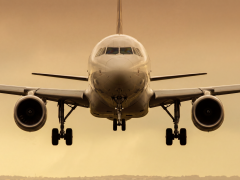
Port congestion hits JIT planning Alan Peat THREE GERMAN multinational car manufacturers - BMW, DaimlerChrysler and VW - are considering the possibility of a dedicated auto part flight between Germany and SA as a crisis measure to counter the effects of port congestion. Barlow Manilal, logistics manager of the Automotive Industry Development Centre at the CSIR in Pretoria, is working on the initiative to fly in parts that would normally go by sea. “Currently the manufacturers don’t consolidate their approach, and we are saying: Let’s try and unify the industry,” he said. But any major additional capacity coming on stream to serve SA motor manufacturers - and any charter aircraft opening a regular service - is not so easy, according to Henry Visser, director of Safcor Panalpina. With high value parts coming in by sea you would be paying the maximum in cargo dues. If you also add the cost of congestion, this could help to balance out the extra for airfreight, Visser added. “But even given this, it doesn’t look like too many parts of vehicles would ever prove airfreightable,” he said. And there’s no big saving using charter flights. “Charter price is related to cargo volume,” said Visser, “and a lot of car parts are high volume commodities. “Even with two way cargoes (giving both south and northbound loads) you’d still be paying market rates of about E1.35-E1.50 a kilogram.” Also, Visser points out that all the motor manufacturers have current airfreight contracts, which can’t just be stopped or changed immediately. These contracts are normally in place for 24months. “Then, if it’s a charter flight you’re talking about, you still have the negotiation of traffic and landing rights to go through.” Toss in the fact that the VW supply chain is now mostly from South America, and you add another problem to the swing to airfreight for German manufacturers. “That would complicate the logistics somewhat,” he added. Not that he negates the sea-to-air switch entirely. “It could be a good idea if all the factors were weighed up,” he said. If the German auto makers do decide to go the airfreight route on a bigger scale, Visser suggests that they look at the Waterkloof air base near Pretoria as the landing and distribution point. “Avoiding the possible congestion at Johannesburg International Airport (JIA),” he said. “But I’d have to stress that it’s not easy.” Manilal agrees. “Projects like this don’t happen overnight,” he said. The Japanese manufacturers have looked at the greater airfreight alternative, according to Henry Pretorius, vice-president at Toyota’s manufacturing plant in Durban, but it has proved a distinct no-no. “Cost is our only concern. Airfreight would be much quicker and would make our just in time (JIT) planning against production line procedures easier. “Availability of aircraft capacity - with Cathay Pacific’s excellent cargo service, for example - is never a problem either “Shipping takes longer, but quantity and cost totally preclude the airfreight option. “Cost, cost, cost. That’s what it’s all about.” And, if you want a picture of what this cost can mean, Pretorius added, just look at a recent Toyota problem. “We had an emergency air input of steel panels,” he said. “That cost us R7-million in freight costs. “And this sort of extra cost we can’t pass on to the consumer. We just have to absorb it ourselves.”
Auto majors consider crisis airfreight measures
Comments | 0
© Now Media. This content is protected by copyright and may not be adapted or republished. If you would like to discuss cooperation opportunities, please contact: editor@freightnews.co.za.