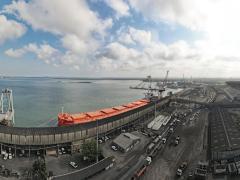
THE BORINGIA led an adventurous life after the outbreak of World War 2. Owned by famous Danish shipping company, Ostasiatiske Kompagni, she had been temporarily seized by the British government. Therefore after the German occupation of Denmark in April 1940 the ship was seen at Cape Town in wartime livery but proudly under the British flag with Glasgow as port of registry. She was built by Burmeister and Wain in 1930 and with a gross tonnage of 5821 tons was a single deck, twin screw ship with accommodation for 38 - 40 passengers. Her engines gave her a good turn of speed at 15 knots. Since the commencement of hostilities, the Table Bay approaches had not yet been threatened by enemy commerce raiders or by submarine attack. That was about to change however; as newer classes of U-Boats with increased range were developed, the decision was taken by the German High Command to direct attention to the South African trade routes, thus sealing the fate of Boringia. On August 1, 1942 Admiral Doenitz issued the order for Gruppe Eisbar (Polar Bear Group) to proceed to Cape Town, which included U-159, a late replacement. At this time the British steamer Kalewa was en route from Glasgow to Table Bay while converging on a similar course for Cape Town was none other than Boringia. Mystery shrouds the collision between these ships off the port which resulted in the sinking of Kalewa while Boringia was able to reach the port. By October 6, 1942 the Gruppe Eisbar had reached Cape waters and awaited signal to attack. Finally the command came at midnight October 7/8 and U-159 under the command of Kapitanleutnant Helmut Witte sighted lights in the distance, speeding off to attack. The first torpedo struck the target amidships and she went down in twenty minutes. The war in the Southern Oceans had begun in earnest – the victim was Boringia, bound for the United Kingdom. The ship went down 200 miles south-west of Cape Town with the loss of nine crew. Her time had come. The next victim was Clan Mactavish which had stopped nearby to pick up the survivors, with the second torpedo fired by U-159, sinking the rescue ship within four minutes. 54 people died, including Boringia’s hapless survivors. Captain Kolls of the Boringia survived. In the coming years the submarine offensive off the South African coast would exact a heavy toll on allied merchant ships, 133 in total being sunk. Much is owed to the courage and valour of the men who braved the elements and dangers of the war at sea. SOURCE OF REFERENCE: JOHN H MARSH MARITIME COLLECTION, IZIKO, SA MARITIME MUSEUM
An ongoing saga of mishaps …
Comments | 0
© Now Media. This content is protected by copyright and may not be adapted or republished. If you would like to discuss cooperation opportunities, please contact: editor@freightnews.co.za.