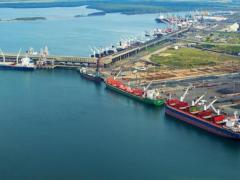
Just four years down the line and South Africa could face the spectre of insufficient containerised and special reefer capacity to move burgeoning citrus volumes to world markets. This grim forecast was made by Paul Hardman, industry affairs manager for the Citrus Growers’ Association, during a reefer logistics forum at Spier Estate outside Stellenbosch recently. A “rather frightening” graph, as reefer trends writer Richard Bright chooses to describe it, is that citrus production volumes have increased from 40 million boxes in 1996 to 91 million in 2008. The CGA suggests this figure will increase further and then level out between 100 and 115 million boxes by 2012, by which time there almost certainly will not be enough reefer capacity, box and/or specialised reefer, to ship it all. While Cape Town-based shipping executives have time and time again given the reassurance there will always be a place for specialised reefer – or conventional underdeck refrigerated shipping – despite the dramatic growth of fruit shipped in containers, Seatrade’s Yntze Buitenwerf warns that unless the citrus sector is prepared to support SRS, it will disappear as an option for the sector. That the citrus sector should have a viable alternative to the container lines may well become all the more important should a new species of fruit fly find its way southwards from Central African fruit crops – a real and present danger, acknowledges the CGA’s Hardman. In this eventuality, there is every reason to believe that citrus exported to the EU would have to be shipped under steri-citrus conditions and as the US and Japan will confirm, on a pallet-for-pallet basis, the specialised reefer is more efficient than the reefer container at upholding stericitrus protocols. Maersk Line’s Mark Cairns acknowledges that there is not only a place but a need for both modes to service the South African citrus industry. The container lines are simply unable to handle current production peaks because of chronic under-investment in the country’s principal export ports. A disquieting picture of the SRS was sketched by Kevin Harding of London’s Sextant Consulting, a man with 30 years’ experience in the containerised and special reefer segments. He says there were in excess of 4 500 container vessels, the average size 2 500 teus, with 325 teus available for reefer cargo, in the world this year whereas there were 774 specialised reefer vessels (non-freezer above 100 000 cu ft), 26% of the SRS fleet between 21 and 25 years old. Thirty-one vessels are to be scrapped this year while few newbuildings are coming on stream. Only 425 are due next year, dwindling to 52 by 2012. Current reefer capacity of the existing container vessel fleet is 1.473 million cubic feet, whereas current underdeck SRS (above 100 000 cu ft) is 265 million cubic feet. The event, attended by a capacity audience of 180, was organised in association with the newly configured Post Harvest Innovation Programme and sponsored by four of the leading specialised reefer operators – Seatrade, Star Reefers, NYKCool and Green Reefers – Safmarine, Capespan, the country’s largest exporter and its chartering arm, Universal Reefers, GoReefers, the independent reefer shipper, Medway Ports and Kloosterboer, two of the EU’s fruit terminal operators, and Containerisation International’s Reefer Quarterly supplement.
Alarm bells raised over growing shortage of reefer capacity
Comments | 0
© Now Media. This content is protected by copyright and may not be adapted or republished. If you would like to discuss cooperation opportunities, please contact: editor@freightnews.co.za.