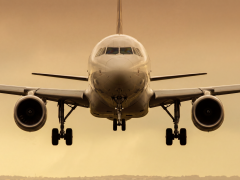
Alan Peat THE BIGGEST industry sufferer after the surprise "plane-bomb" attack on New York and Washington has been - rather inevitably - the airline sector. The short- term net losses for international scheduled traffic and domestic US traffic, according to the finance committee of the International Air Transport Association (IATA), could easily exceed US$10-billion. Indeed, the complete three-day lock-up of US airspace to all but military aircraft, was estimated to be costing about US$1-bn a day. Faced with a big demand slowdown - not expected to rise above 80% of previous volumes for some time - US airlines are cutting back service dramatically to avoid bankruptcy. United Airlines, Northwest Airlines, US Airways, Delta Air Lines and American Airlines are all cutting their nationwide (and some their international) flight schedules by up to and above 20% due to the demand drop. Continental Airlines seems a particular sufferer having cut flights to 10 destinations worldwide and announcing that 12 000 workers would be going Òon furloughÓ. However, US Airways has also shed 11 000 staff and job losses at others seem inevitable. After share trading in New York resumed, airlines were the biggest financial victims of the attacks on the US. ContinentalÕs share price lost 49%; American Airlines dropped 39%; US Airways lost 51%, Delta 44%, and United Airlines 43%. That was far more than the Dow Jones Industrial Average which fell 7.13% on opening day. This call for relief was urgent, according to industry insiders, if certain airlines are not to go to the wall. But the effects were also more widespread in their repercussions. Aircraft manufacturer Boeing plans to lay off as many as 30 000 aircraft workers by the end of next year as a result of an expected slowdown in orders caused by the attacks. At the same time, stock prices for the worldÕs major airlines also plummeted - some losing by as much as 50% of their market values. Particularly hard hit, according to the Economist, were Air New Zealand and British Airways (already facing tough times). It also expects the impact on non-US carriers in the near future to be ÒseriousÓ. On the job loss scene, Virgin Atlantic was quick to announce that it was to cut 1 200 staff jobs in response to the aftermath of the terror attacks. In looking for answers, the European Union countries have pressed for a worldwide system of auditing airport security - and an upgrading of international air safety rules. The EU governments have also agreed to co-ordinate their own airport and aircraft security controls - while the UK is considering posting armed guards on its airliners to prevent the kind of suicidal airborne attacks launched against Washington and New York. The continuing ban on air cargo being carried by passenger aircraft is expected to have a detrimental effect on airfreight movement.
Airlines bleed
Comments | 0
© Now Media. This content is protected by copyright and may not be adapted or republished. If you would like to discuss cooperation opportunities, please contact: editor@freightnews.co.za.