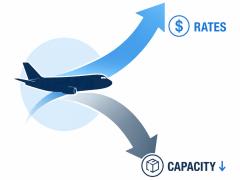
The African airfreight industry needs to stop operating in survival mode and focus on taking advantage of the positive swing in global trade by not only elevating its international growth potential but by stimulating intra-Africa trade. “Air cargo currently brings in 12% of revenue for Iata carriers compared to the 4% of revenue delivered by first class passengers and 8% by business class passengers, and it is time the African airfreight industry makes its collective voice heard by collaborating to address some of the challenges which impact on its potential for growth,” said Des Vertannes, global head of cargo at the International Air Transport Association (Iata), speaking at the Air Cargo Africa 2013 Conference in Johannesburg recently. Some of the challenges highlighted during roundtable discussions by delegates included African carriers upping their game in terms of professionalism, the ever-increasing fuel costs, security surcharges (up to one US dollar per kilogram), losing out to other modes of transport into Africa (such as road and rail) due to high costs via air, the imbalance of import/export load factors, as well as market barriers for African carriers to compete effectively in a global playing field. Sanjeev Gadhia, CEO at Astral Aviation, suggested that multiple hubs serving Africa were the answer to addressing imbalanced cargo load factors. “If carriers combine their route strategies they can de-feed cargo on routes where exports are higher,” he said. Mbuvi Ngunze, chief operating officer at Kenya Airways, also suggested that the industry consider diversifying and looking at new markets to serve. “African airlines facing market barriers should also consider forming alliances with foreign carriers, which would effectively allow for traffic in every direction,” he added.
'Africa must step up to its potential'
Comments | 0
© Now Media. This content is protected by copyright and may not be adapted or republished. If you would like to discuss cooperation opportunities, please contact: editor@freightnews.co.za.