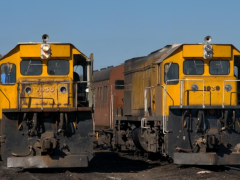
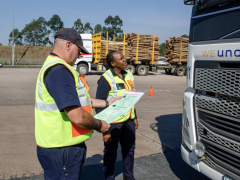
By switching from Durban to Walvis Bay, a client in Lusaka won a contract with major retailer Shoprite because he was able to offer improved and predictable transit times. It’s one of several success stories that Walvis Bay Corridor Group CEO Johny Smith outlined last week when he updated FTW on grand plans not only to upgrade the port but also the road and rail infrastructure which are crucial elements of the supply chain mix. “Ten years ago when we started this initiative, Walvis Bay had no direct callers – now we have connections to all major trade lanes,” Smith told FTW. “Our objective is to develop Walvis Bay as an alternative trade route serving Angola, Botswana, Zambia, Zimbabwe, DRC, Gauteng – and even as far as Malawi and Tanzania because of transit time you can save along this route,” said Smith. Focusing on the Gauteng market, he believes Walvis Bay adds value for timecritical cargo. “Ships from Europe and the Americas have to pass Walvis Bay – and from Walvis Bay to Durban takes 5-7 days by sea. If you offload in Walvis Bay, it takes two days. Since 1994, the port has invested R800m and the draught has been deepened to 12.8m. “Ten years ago we handled 20 000 containers – last year we handled 260 000.” And according to Smith, the port will invest R2.7-bn in next 3-4 years, deepening the draught to 16m and doubling capacity to 500 000 TEUs per annum. And the investment, says Smith, is all about cutting the cost of logistics for the region, and this involves the intermodal links as well. “There’s a missing link in terms of railways along the Trans Kalahari Corridor – the railway stops 140km before you reach Botswana and then continues from Lobatse. There is 700km of railway missing but the Namibia and Botswana governments have put out an expression of interest for the railway between Botswana and Namibia. “There’s a lot of coal in Botswana and they are looking at an alternative through Namibia or the east – we are trying to run faster than Mozambique to ensure that Namibia gets the business.” Significant progress has also been made with regard to border hours. “In 2007 the border hours were extended. But a recent agreement between Botswana, Namibia and South Africa will see the introduction of a 24-hour border.” According to Smith, it’s just a question of sorting out human resources requirements between the various agencies involved. “We believe we have developed a very good alternative trade route – and that people should have choices. “Ultimately the benefit for Southern Africa is that we can reduce the cost of logistics not only by reducing transit time but through the additional benefits of competitive rates, a congestion-free port and zero pilferage.”
Walvis Bay switch swings major contract for Lusaka shipper
Comments | 0
© Now Media. This content is protected by copyright and may not be adapted or republished. If you would like to discuss cooperation opportunities, please contact: editor@freightnews.co.za.