In a private round-table discussion with a group of selected journalists, several of whom have been responsible for exposing corruption at Transnet while the Gupta brothers and their Zuma lieutenants still pulled executive strings, the freight and rail parastatal indicated that its “cleaning up” process was proceeding well. Acting group chief executive, Tau Morwe, at one stage
compared the state-owned logistics company to a car whose indicators weren’t working but, thankfully, whose wheels at least remained intact. Not to put too fine a point on it, interim chief financial officer Mohammed Mohamedy, even struck a comparison with Eskom, saying that as far as Transnet’s finances were concerned, they were nowhere near the same
situation. To be fair, Morwe added that “there are things that are going right but there is a lot that is going wrong”. The so-called “lot”, relatively speaking, was identified as Transnet National Ports Authority, Transport Port Terminals, and Transnet Pipe Lines that, bar basic regulatory issues, urgently required berth and draught deepening, as well as personnel and equipment challenges, were doing fairly well. As for that which is not working, “Transnet Freight Rail is our biggest problem at the moment,” he stressed, adding that it had become the pivot of restructuring at the parastatal. As stated previously, Morwe said, “It’s the starting point of Transnet’s cleaning-up process. “We believe that if we focus on sorting out issues at TFR we should, within a year, start seeing the benefits at an operational level that should also translate into better finances.” And that process, of solving backlog issues on various of its bulk freight lines, is already well under way. Morwe said, among other things, that TFR last year moved 236.4 million tonnes – “a high level” of freight. And this year, through concerted efforts to sort out delays on its bulk lines to Saldanha and Richards Bay, including “ongoing discussion” to improve efficiency on the north-south corridor to the Copperbelt area of Zambia and the Democratic Republic
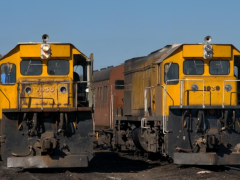
of the Congo, it’s already seeing an increase in bulk volume of 215 million tonnes. Regarding Transnet’s books, these are looking surprisingly healthy, Mohamedy said. Figures were bandied about but as the media session in the parastatal’s inner sanctum was called in private, journalists were requested to keep certain salient facts to themselves. The gloves, however, came off when Mohamedy was probed about the state of investigation into contracts awarded to four original equipment manufacturers (OEM) for delivering 1 064 locomotives, contracts that in large part appear to have formed part of state capturing. Responding to an allegation that feet were been dragged as Transnet’s date with the Zondo Commission looking into state capture nears in May, Mohamedy denied that some of the OEMs were refusing to see the board. “We’re a different board now compared with 12 months ago with entirely different objectives. They (the OEMs), have given us timelines to respond to their queries and we intend to discuss matters with them at the appropriate time.”
Transnet talks restructuring at closed media session
Comments | 0
© Now Media. This content is protected by copyright and may not be adapted or republished. If you would like to discuss cooperation opportunities, please contact: editor@freightnews.co.za.