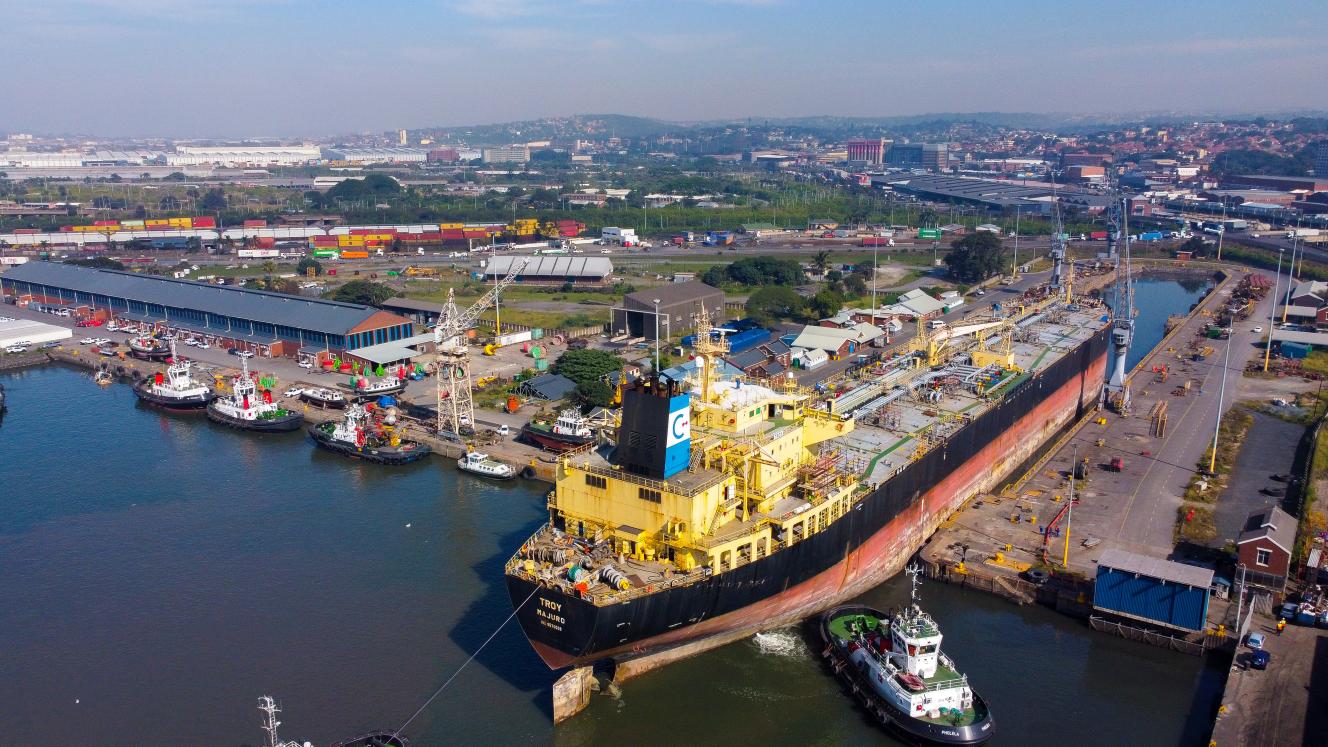
The prospect of public/ private partnerships (PPPs) in Transnet developments is getting closer, according to Chris Matchett, Transnet National Ports Authority (TNPA) executive head infrastructure. There is nothing firmly on the board right now, “but there is a lot of numbering now taking place,” he told FTW. It’s all part of a “growing realisation” that funds in government departments are anything but inexhaustible, and that financial ambitions have to be restrained by just what Transnet’s gearing justifies. Parastatal Transnet’s balance sheet cannot accommodate the R230-billion, 30-year port development plan as it currently stands, according to Matchett. “This is why public-private partnerships (PPPs) are becoming a viable proposal. Eighteen months ago PPPs were not on the cards, but the climate is changing dramatically. We are setting up internal workshops on how to approach PPPs. “My guess is that we will see the start of projects going out on that basis in the next two years.” Part of this lies in the multi-billion aspiration for TNPA to develop another Durban port on the site of the old airport. “We’re quite bullish about this,” Matchett said. “And the way we’re looking at it is that the operators of the various facilities will be private sector.” TNPA intends this allocation to be governed by the conditions of the National Ports Act. “They would go out into the market on an open tender basis,” Matchett added, “where Transnet Port Terminals (TPT) might also be involved, but where the final decision will be dependent on the bids made.” He even sees the private sector being involved in the basics like quay wall development. “I can see us tracking backward to get PPPs together for infrastructure,” Matchett said. “Here they would have a very real return in a specific time from port tariffs, which would make it an extremely attractive proposition. “At the same time we would benefit from outside funding, because something like this could never be a go-it-alone situation.” It also has to be seen as a concept that would help to improve SA’s logistics competitiveness not only with our fellow developing economies, but even with those of more developed nations. This chase was highlighted in a report detailing research into transport and logistics trends in the decades ahead, which was released to FTW by Pricewaterhouse Coopers. It suggested that trade volumes would shift towards emerging markets and least developed countries would take their first steps into the global marketplace – and it named Brazil, China, India, Mexico, Russia, SA and Turkey as among primary players (See page 20). Imperial Logistics marketing director Abrie de Swardt even took this concept one step further. He believes that SA has the potential to outperform much larger and more established economies. “As logistics and supply chain processes enable or disable a country’s expansion and growth and thereby its global competitiveness, SA’s rating of 28th out of 155 countries on the global Logistics Performance Index (LPI) indicates an increasingly competitive sector, with the potential to outperform much larger, more established economies,” De Swardt said. Excluding high-income countries such as Germany and the USA, SA is among the top 10 logistics overperformers in the survey, keeping company with the likes of China and India, he added.
Transnet sets up internal workshops on way ahead for PPPs
Comments | 0
© Now Media. This content is protected by copyright and may not be adapted or republished. If you would like to discuss cooperation opportunities, please contact: editor@freightnews.co.za.