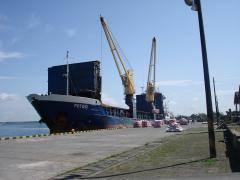
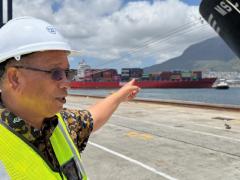
The creation of a hub port in South Africa is high on the agenda for Transnet Port Terminals and it’s likely to shape the shipping future of this country, TPT CE Tau Morwe told FTW. Detailed studies are currently under way to establish the most practical option. “Right now we are looking at Durban, Richards Bay and Ngqura,” he said. “One of the things we don’t have is short-sea shipping, and with the introduction of a hub one of the key requirements will be connectivity – by land and by sea.” This will see the creation of more short-sea shipping companies – and the more short-sea shipping companies we introduce the more cargo will come to South Africa. And this will be cargo destined not only for South Africa but for East and West Africa, the Indian Ocean Islands, Madagascar and beyond. “It will change the nature of shipping in southern Africa – and the region generally.” Morwe expects recommendations on where the hub should be located to be available by December or January after which implementation will begin. “The hubbing strategy, once implemented, will have an impact on the way we are utilising our terminals,” said Morwe. At present Cape Town, for example, doesn’t compete with Durban or Port Elizabeth. Each port has a hinterland and containers coming into Cape Town are generally destined for Cape Town. “Five to 10 years from now our ports will be gateway ports and gateway terminals within the context of a hub. We will have major vessels coming into the hub and dropping off or picking up cargo while the various short-sea shipping vessels would take the cargo from the hub into the other major ports.” It’s an exciting new era that presents many opportunities and challenges. And when it comes to challenges, TPT faces several in common with the rest of the world – the skills shortage, creating capacity ahead of demand and new environmental requirements to mention a few. Only a few terminals and ports anticipated and prepared for the growth in demand, says Morwe. “We now have a situation where our terminals are running out of capacity. In Durban we are looking at Salisbury Island, Pier 1 is now on stream, Ngqura will be ready next year and Cape Town is also undergoing significant upgrading. The investment figures speak for themselves. In 2000/01, capital expenditure by the ports amounted to R131m. For the financial year ended 2007/08, R3.2m was budgeted and close to R2m spent due to some cancelled projects. “So capex has increased exponentially – and going forward this trend will continue,” said Morwe, with R3bn budgeted for this year. And the current financial crisis is unlikely to provide much breathing space for the congested container terminals. “Volumes are slightly down, but it’s the car shipments, bulk and breakbulk that have been most severely affected “For containers we can’t relax – although there has been a slight dip we have to continue creating capacity.” And creating that capacity is not as simple as it used to be. Environmental issues and a shortage of skills add challenge to the mix. “We are already seeing that importers are insisting on carbon footprint when sourcing products – so the more environmentally-friendly our terminals are the better for products imported from South Africa. “When we procure equipment we are looking at equipment that can use both diesel and electricity so that we can switch on and off between the different power modes.” And in the area of skills, TPT has set up its own School of Port Operations. “In the past the Port Academy was run by the National Ports Authority. “We are currently taking on students with matric science and maths and training them as artisans. “The employee of the future, 10 years from now, will be different from our current employees. They will be much more technically oriented. Even the driver of a crane or straddle carrier will have the technical knowledge and experience.” TPT is in the process of setting up the school and recently brought in a group of Sri Lankans to train its employees. “We will bring in people from Germany’s Hamburg Port Training Institute who will be training local students.” It’s not only an investment for TPT, but for the country as a whole.
TPT keen to promote short-sea shipping
Comments | 0
© Now Media. This content is protected by copyright and may not be adapted or republished. If you would like to discuss cooperation opportunities, please contact: editor@freightnews.co.za.