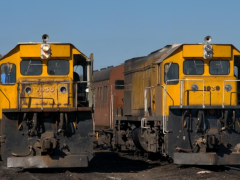
The launch by Transnet Freight Rail of a scheduled service that guarantees arrival and departure times of each train on every node of the rail route is the first step towards a truly 24/7 service, 364 days a year. That was the message from CEO Siyabonga Gama when he announced the launch of the new initiative that will see fixed scheduling of freight trains – initially on four key corridors. The success of the venture will however demand buy-in from every link in the supply chain. “When it comes to Saturdays and Sundays our customers close so logistics can’t be optimised.” And that, says Gama, is an ongoing conversation that will need to be resolved. The first phase of fixed scheduling will apply on the Phalaborwa/Maputo and Richards Bay line for magnetite; Welgedag/Palmford for Majuba coal; Uitkyk/ Komatipoort for TCM coal; and Phalaborwa/Richards Bay for rock phosphate. The busy Natcor corridor between Gauteng and KZN is next on the schedule, with the entire network running to a scheduled timetable by mid-2012. “We also want to increase the number of trains on Natcor – currently 35 a day each way – to 55 in the next three years,” he said. It’s all part of TFR’s drive to move rail-friendly volumes from road back to rail. “In order to achieve that we need to launch programmes that bring about better predictability and reliability of our railway system which is what our customers want. “Scheduled railways will also help us to deliver more tons on time which will make it possible for us to deliver more tons. Predictable and cheaper rail transport will move traffic from road to rail.” Customers will however require some convincing. Project manager of Into Africa Logistics, Michelle Stuart, has her doubts. Her company recently chose to rail four containers to Cape Town and Port Elizabeth due to cost concerns. “It took 17 days from receipt of the containers to reach their destination! The demurrage incurred nullified any savings, and Transnet refused to entertain any claims. “This happened less than a week ago,” she said. “How is this going to suddenly become an efficient service?” Danie Grobbelaar of Cardio Med agrees that Transnet is the way to go but he also has his doubts. “It should be more cost effective, but the problem is reliability and safety of cargo,” he told FTW. Last week’s launch covers 19m tons of TFR’s general freight business. “That represents about 21% of the business we do on general freight – which is a start. “We’ve looked at corridors where there is a lot of product moving and we want to gradually upscale into other important flows within the TFR environment,” said Gama. “But at the same time we want by mid next year to operate a fully scheduled rail service.” The ultimate goal is not to compete with road but to improve the competitiveness of South Africa’s logistics chain.
TFR puts its credibility on the line
Comments | 0
© Now Media. This content is protected by copyright and may not be adapted or republished. If you would like to discuss cooperation opportunities, please contact: editor@freightnews.co.za.