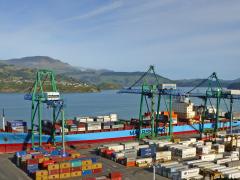
Breaking records and accomplishing world firsts is all in a day’s work for the project team involved in the logistics of the specialised cargo needed in the construction of a solar plant in South Africa’s semi-desert Northern Province. Having just completed the mammoth task of shipping and delivering the first of two 335t heat exchangers to KaXu, the 100MW parabolic trough solar power plant under construction near Pofadder, the team from Global Logistics Alliance (GLA), Berry & Donaldson and ALE Heavylift South Africa (ALE) pulled out all the stops to make sure nothing was left to chance. “That is part and parcel of success in the project cargo field,” says GLA’s chairman, Giuseppe Arnoldi. “You don’t take chances and you plan in the finest detail to make sure that you cover every possibility and eventuality.” This is not as easy as one may think in the complex African project cargo landscape where just about anything and everything can go wrong at the drop of a hat. Jason Schouw, projects manager for Berry & Donaldson, believes experience and communication are integral to the success of any project. ”There truly is no room for error and therefore the various parties involved have to work together very closely, constantly communicating with each other and making sure that they know what is happening all the time. Experience goes a long way in project cargo because this is a complex environment with expensive cargo being transported in difficult conditions. Any damage to cargo can see a project being held up for months – which of course could have massive financial repercussions.” Johann van Zyl, project engineer for ALE, which was responsible for the heavylift equipment needed to move the heat exchanger, commented: “A lot of planning went into the movement of this particular piece of cargo and it ultimately paid off as we managed to deliver the cargo without incident within eight driving days,” he told FTW. Kaxu is one of three solar projects in which the three companies are involved at present. The decision was made to bring in the cargo – weighing in at 335 tons – via the Port of Luderitz in Namibia and then transport it by road to Pofadder. “Luderitz was chosen as it was the easiest route with the least amount of bridge propping and road upgrades,” said Van Zyl. But moving cargo of this size is no mean feat. Three trucks with 650 horsepower each were used to pull the trailer that had a width of 4.05 metres and an axle-line spacing of 1.5 metres, with a fourth truck of 735 horsepower used to push from the back. With some 380 wheels in total, Van Zyl says it is the heaviest cargo that has ever been transported on Namibia’s public roads. Covering the 985km from the port to the KaXu solar power plant near Pofadder was slow going with the convoy only travelling an average of around 20km per hour and only in daylight. And having completed the task the team are now doing it all again as the second heat exchanger is taken to its final destination. INSERT You don’t take chances and you plan in the finest detail to make sure that you cover every possibility and eventuality. – Giuseppe Arnoldi CAPTION A long and winding road … the heat exchanger on its way to Pofadder.
Team work delivers 335t heat exchangers to Pofadder
Comments | 0
© Now Media. This content is protected by copyright and may not be adapted or republished. If you would like to discuss cooperation opportunities, please contact: editor@freightnews.co.za.