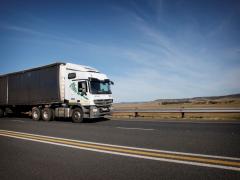
Costs, rather than concern for the environment, are often the prime motivator of green initiatives – and the transport industry is no exception. But whatever the motivation, says Harmke Immink of carbon consultants Promethium Carbon, it’s critical for companies to establish their footprint – and that involves finding the base line and understanding the main contributors to Greenhouse Gas emissions. “The baseline will identify the priority areas for emission reduction initiatives,” says Immink. While reducing electricity usage at headquarters is probably still the most effective means of reducing carbon emissions, in the transport industry route optimisation has been one of the key interventions – for many driven largely by the cost reduction motivation. A lot of it is practical common sense and good housekeeping, says Immink. “Distributors of refrigerated goods no longer keep the refrigeration operating once the cargo has been offloaded. They switch the engine off while they’re loading and offloading, and don’t idle the vehicle before starting their journey. “If diesel was cheap, behaviour would possibly not have changed as speedily.” But not all interventions are simple. Moving to a more fuelefficient or hybrid fleet, for example, would cut diesel by half, but it needs to be phased in over time. You can’t replace a fleet overnight. A construction company however discovered that by doing more maintenance than was necessary, they not only saved money on breakdowns, but the vehicles became more fuel-efficient. It’s clearly a mindset that is starting to shift over time. There’s also increasing interest in biodiesel, says Immink. “It’s a renewable resource that comes with zero emissions. And by using a blend of biodiesel and fossil fuel you can reduce carbon footprint.” While the production of biodiesel does raise the food versus fuel issue, waste cooking oil has been established as a perfect biodiesel. “Currently in South Africa our waste cooking oil is absorbed in the animal feed industry, but the revised Waste Act is expected to resemble international practice, which means we will have huge quantities of waste cooking oil available for biodiesel. Why use fossil fuel if you can use a renewable one?” Another Promethium Carbon customer has made significant inroads through clever management of logistics around paint and paint products. “The company moves one large truck to a central distribution point in Angola and from there smaller trucks are used for shorterdistance distribution, which reduces the cost of diesel and carbon emissions.” Essentially, says Immink, it’s a question of developing a frugal mindset. “Some of the warehouses with the lowest carbon footprint have achieved this status not only because the management knew about carbon footprint but rather because they were frugal – switching off electricity and air-conditioners and looking for fuel-saving interventions.” A delivery depot took it a step further and offered customers the option of collecting rather than waiting for delivery of their products. “This was servicedriven, but ultimately saved on fuel and reduced carbon emission because delivery trucks could then take a more direct route.” Overpackaging is another area of focus that has made significant impact. The wine industry is increasingly moving to bulk transport – although the motivation is often questionable. Is the country of destination keen to create jobs by setting up a bottling facility or is it driven purely by ‘green’ motivations. “Overpackaging happens very quickly,” says Immink. “It’s difficult to design out and has a huge impact on logistics – it means using a big truck to transport something that could go on a bakkie.” Several large retailers in South Africa have active programmes in place to reduce overpackaging. While individual companies are increasingly taking control, there’s a lot of subcontracted business in the logistics industry – so the idea is to calculate carbon footprint in the context of the whole supply chain. “That’s where you can make the difference in choosing upstream and downstream. “Sometimes companies may do things to reduce cost, or for reasons of safety – but for progressive companies, calculating the carbon footprint is an additional means of making an informed decision.”
Some easy steps to reducing carbon footprint
Comments | 0
© Now Media. This content is protected by copyright and may not be adapted or republished. If you would like to discuss cooperation opportunities, please contact: editor@freightnews.co.za.