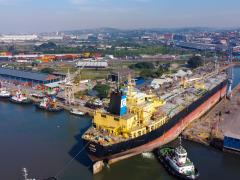
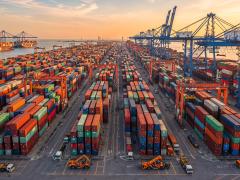
New train sets, road, rail and port upgrades, and a onestop border post are just some of the developments over the past two months aimed at improving efficiencies on the Dar es Salaam corridor. The results of the focus by both the Zambian and Tanzanian authorities on the corridor were evident in FTW’s recent visit to Lusaka and Ndola. A number of forwarders said they had switched or returned to Dar es Salaam because of the improved efficiencies of the route and lower costs. It is estimated that 41% of the transit traffic passing through Dar es Salaam originates in Zambia. This is taking traffic away from Walvis Bay, Durban and Beira. Logistics companies now need a presence in all four ports in order to provide the flexibility that commodity exporters in particular demand. The Dar es Salaam port is expected to raise its cargo volume by 25% by the end of 2015, Tanzanian President Jakaya Kikwete told parliament in June. Volumes will increase from 14.4 million tons of cargo a year to 18 million tons over the short term and to 28 million tons by the end of 2020. The construction of two new berths is set to increase the number of containers being handled by the port from 0.6 to 1.2 twenty foot equivalent units (TEUs). According to the Central Corridor Transit Transport Facilitation Agency, work has started on a US$596-million upgrade to the port, which is due to be completed by 2020. Between 2003 and 2013 there was an annual average growth of 16.5% in transit volumes through the port, according to the agency. Delays at the Nakonde border post between Zambia and Tanzania are also being addressed. On June 19 the governments of Tanzania and Zambia signed an agreement to reduce transport costs along the Nakonde-Tunduma corridor linking the two countries by eliminating non-tariff barriers. It is part of two bilateral agreements for the improvement of the regulation of cross-border transport for passengers and freight. In terms of the agreements, Tanzania and Zambia will also work together to improve road infrastructure. Steps have already been taken to upgrade the rail link. Four new cargo train sets were added to the route in June, and plans for a central rail corridor are quite far advanced. The Tanzania Ports Authority (TPA) is also being more aggressive in its marketing, with the opening of a new liaison office in Lusaka, and at the same time announcing that it is investing US$10 million in a new Electronic Single Window System (ESWS) that will integrate all the operations through an interface that can be accessed from any computer where it is installed. Clearing agents will be able to file remotely rather than going into the port. The office in Zambia will also be able to deal with queries and problems in Lusaka, instead of Zambian businesses having to go to Dar es Salaam to sort out paperwork issues, according to TPA. Representatives will also not have to carry large sums of money for the payment of shipping fees, the Tanzanian deputy minister of transport Charles Tizeba said at the opening of the office.
Shippers tune into improved Dar es Salaam efficiencies
Comments | 0
© Now Media. This content is protected by copyright and may not be adapted or republished. If you would like to discuss cooperation opportunities, please contact: editor@freightnews.co.za.