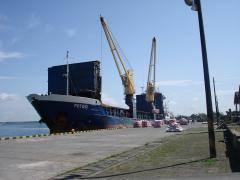
Feasibility study to narrow down three contenders Ray Smuts THE PORT of Saldanha’s quest to diversify over and above iron ore and steel coil exports will be given a huge boost - as indeed will the entire Cape West coast - should it be chosen for the siting of an LNG (liquid natural gas) plant that is part of a multi-billion rand development in the Western Cape. PetroSA, the state-owned oil company, has identified Saldanha along with the Ports of Mossel Bay and Ngqura (Coega) as potential sites and is in the midst of a technical feasibility study which includes an ‘environmental fatal flaw’ analysis. Saldanha port manager Eugene Kearns confirmed to FTW last week that flowing from American company Forest Oil International’s investigation into offshore gas development and onshore market development (FTW June 27, 2003) was a preliminary investigation into the best possible location for the plant expected to be in place by 2006. “For us the benefits would be enormous as we will not only be gaining a significant (oil company) tenant but more marine-related activity, more jobs, and engineering infrastructure for which the basics are already in place. “Our commitment boils down to developing port land, and were we to win out over Mossel Bay and Coega, our contribution would be to provide infrastructure such as roads and electricity leading to the actual plant.” Port engineer and infrastructure manager Mags Ruthenavelu says one of the most positive spin-offs of an LNG plant in the Port of Saldanha is that an additional vessel will call every other day, equating to 120 more vessels a year or a 30% growth in traffic. A 30ha site to the east of the port, not far from Saldanha Steel and well clear of inhabited areas and other industry, has been identified as most suitable for the proposed plant. That the Port of Saldanha and its sister the Port of Cape Town are both out to capture a slice of the hugely lucrative West African oil bonanza is an open secret, despite the National Ports Authority decree that ports should not compete but rather complement one another.
Saldanha hangs its hopes on new liquid gas plant
Comments | 0
© Now Media. This content is protected by copyright and may not be adapted or republished. If you would like to discuss cooperation opportunities, please contact: editor@freightnews.co.za.